 +44 7933 142807
 info@assignmentmaster.org.uk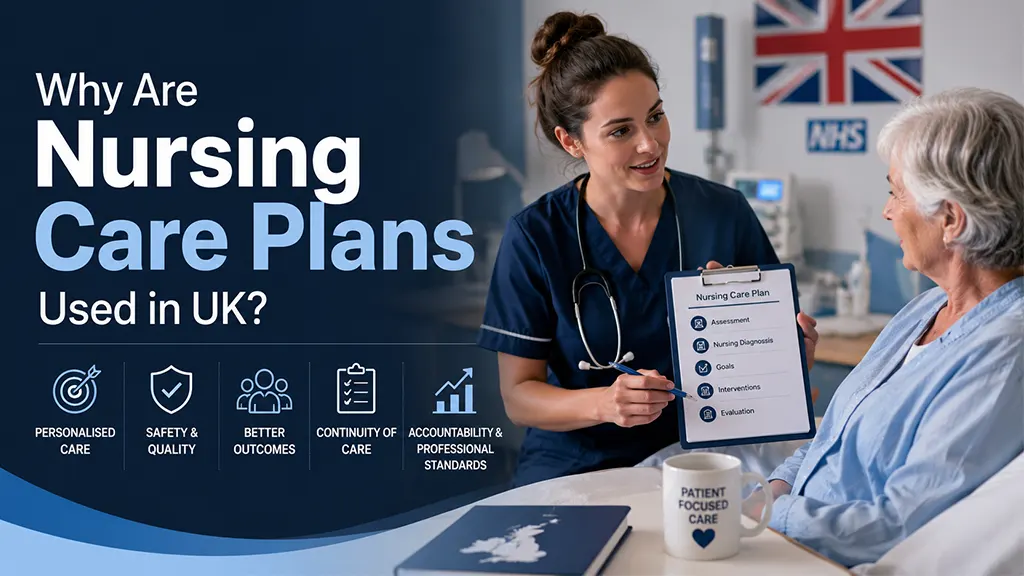
 By
By Nursing care plans are one of the most fundamental tools in the UK healthcare. They ensure safe and patient-centred care plans across NHS hospitals, community services, and care homes.
However, many students and even some qualified practitioners lack a clear understanding of what they are, what they must contain, and how they directly affect patient care. This blog addresses all of that in the context of UK nursing standards, current NHS practice, and the law that rules care delivery in England, Scotland, Wales, and Northern Ireland.
Nursing care plans remain at the centre of the professional responsibility of a nurse or student. So let us understand how nursing care plans are structured across different care settings, and what the evidence says about their measurable impact on patient safety and outcomes.
What Is a Care Plan in Nursing?
A nursing care plan is a written, structured document. It records a patient’s assessed needs, the goals set to address those needs, the interventions the nursing team will carry out, and how progress will be evaluated over time.
Think of it as a personalised roadmap. An outline that shows what the nursing team is going to do, by when, and how they will know if it is working. Crucially, it is a living document that changes as the patient’s condition changes.
In the UK, nursing care plans are built around the five-stage nursing process taught on every registered nurse training programme.
| The 5 Stages of a Nursing Care Plan (ADPIE)
Assessment: This is the first step that gathers information about the patient’s physical, emotional, psychological, and social needs. Nurses are responsible for collecting and maintaining this data. Diagnosis: This stage uses the subjective and objective data collected in the first step. It identifies nursing problems based on assessment findings, distinct from medical diagnoses. Planning: after agreeing with the diagnosis, nurses have to plan a course of treatment that takes into account short and long-term goals. You set SMART goals and identify the most appropriate interventions. Implementation: This is when you put the plan into action. It is also documented as it happens. Reviewing: this is the last step of the ADPIE framework. Nurses and the treatment plan review whether goals have been met and adjust the plan accordingly. |
The Scale of the Challenges: Key UK Statistics
To understand how important nursing care plans are in the UK, consider the immense number of patients the NHS manages every day.
Informal or inconsistent approaches to care do not work at that scale. Therefore, structured nursing care plans are not optional. They are the operational necessity.
What is a Care Plan in Nursing? The UK Legal and Professional Picture
What is care planning in nursing in the UK? It goes beyond filling just a form. Care planning is a professional and legal responsibility. The Nursing and Midwifery Council (NMC) Code of Conduct rules all registered nurses and midwives in the UK. It makes clear that nurses must assess needs, plan care, and act as a patient advocate.
Why Are Nursing Care Plans Used?
There are many reasons to use nursing care plans that most people realise. The following are the most important ones:
They Bring Order to Complexity
Patients rarely have just one health problem. A 65-year-old on a surgical ward might have Type 2 diabetes, limited mobility, post-operative pain, and anxiety. All at the same time. A nursing care plan allows the nurse to tackle each issue in a prioritised, systematic manner.
They Enable Safe Handovers
Ten or more healthcare professionals might see a patient on a busy NHS ward in a single day. So without a clear shared record, critical information gets lost between handovers. This is where nursing care plans are the most important. It gives every member of the team the same accurate starting point, regardless of when they arrive on the shift.
They Keep Patients at the Centre
Person-centred care is the main principle of the NHS Long Term Plan. Nursing care plans are built around the individuals. They capture not just clinical symptoms, but the patient’s own preferences, cultural background, language needs, and personal goals. Any nursing plan that is developed without patient input is considered poor practice under the current NMC standard.
They Provide Legal Protection
Healthcare documentation is legal evidence. A well-maintained nursing care plan provides a dated and signed record of what was assessed, planned and delivered under the scenario of if a complaint arises. This is why NHS Resolution consistently highlights inadequate documentation as a factor in avoidable legal claims.
They Support Continuity Across Settings
Patients move between wards, hospitals, GP surgeries, and community services. A well-written nursing care plan travels with them. This ensures that no critical information is left at a transition point.
Struggling to write your nursing care plan assignment?
Care planning is complex and so are writing these plans. If you are a nursing student in the UK and find it difficult to apply the ADPIE framework or structure your care plan correctly, our expert writers are here to help Get Expert Nursing Assignment Help!

Nursing Care Plans Examples in Clinical Practice
Looking at factual nursing care plan examples makes the process easier to understand. The following table shows four real-world scenarios commonly seen across the UK healthcare settings.
| Patient situation | Nursing diagnosis | Goal | Key interventions |
|---|---|---|---|
| Post-surgical patient, day 2 | Acute pain related to the surgical wound | Pain score ≤3/10 within 2 hours | Dispense prescribed analgesia, monitor, and reposition regularly |
| Elderly patient with limited mobility | Risk of pressure ulcers | Skin integrity was maintained throughout admission | 2-hourly repositioning, pressure-relieving mattress, Waterlow scoring |
| Patient with Type 2 diabetes | Unstable blood glucose levels | Blood glucose within an agreed target range daily | Regular BM monitoring, dietary support, and insulin as prescribed |
| Patient with pre-operative anxiety | Anxiety due to the upcoming procedure | Patient reports feeling informed and calm prior to theatre | Clear explanation of the process, answer questions openly, and involve the family |
These nursing care plan examples show how the plans move consciously from a broad to a specific and then targeted actions. This precision separates structured nursing from reactive guesswork.
| Need a Professionally Written Nursing Care Plan for Your Assignment? Our UK-based nursing writers can craft a fully structured, NMC-compliant care plan tailored to your specific case scenario. They are delivered on time and 100% plagiarism-free. Seek Nursing Care Plan Assignment Help Now! |
The Comfort Nursing Care Plan- When Cure Is Not the Goal
Not every patient comes into the hospital to be cured. Many patients are in the last stages of life or living with conditions that cannot be reversed. The primary aim of those patients is comfort.
A comfort nursing care plan is created specifically for this group. It focuses on relieving suffering, upholding self-respect, and supporting both patient and family through this difficult time.
More than half a million people die in England each year. According to the BBC, it is estimated that at least three-quarters of 650,000 people who die every year in the UK require palliative care.
A well-constructed comfort nursing care plan is not a lesser version of standard care. It requires equal skill and much more sensitivity.
A comfort nursing care plan typically addresses:
- Pain and symptom control: It uses validated tools like the Abbey Pain Scale for patients who cannot self-report. It also requires regular reassessments.
- Oral and skin care: this includes mouth care every two to four hours and repositioning to prevent pressure damage. It also monitors for signs of distress.
- Emotional and spiritual support: This offers access to chaplaincy, counselling, and conversations about fears or wishes.
- Family communication: It clearly documents what information is shared with the relatives and who the key contacts are.
- Anticipatory prescribing: It works with a massive team to ensure medications for pain, breathlessness, and agitation.
The end of the Liverpool Care Pathway in 2014 made individualised comfort nursing care plans even more important. Every patient needs a plan that is developed around their specific conditions, not a protocol applied wholesale.
Nursing Care Plans in Mental Health Settings
Mental health nursing is one of the four fields of nursing practice in the UK. The nursing care plans here look quite different from those used on a general medical ward. The general plans focus on physical symptoms. But these plans centre on clinical measurements to therapeutic relationships, risk management, and recovery goals.
In mental health settings, a nursing care plan must address a patient’s mental health state, thei risk to themselves or others, social circumstances, and personal goals. This requires a great collaboration with the patient.
| Why this matters: NHS England’s 2024 Mental Health Plan reported that approximately 3.8 million people are in contact with NHS mental health services. The demand for mental health nursing has never been greater. Hence, effective nursing care plans are important to manage this safely. |
Nursing Home Care Planning – Long-Term, Complex, and Regulated
Nursing home care planning in the UK works under a different set of pressures to hospital care. People often live in the same home for years. This means their plans are not episodic documents. In fact, they are an ongoing record that progresses with the person over time.
Under the Care Act 2014, local authorities in England are legally required to assess the care needs of any adult appearing to have such needs, regardless of their financial resources. It also ensures that personalised care plans are in place.
Nursing home care planning in 2026 must adhere to the Care Quality Commission (CQC) Single Assessment Framework. Their inspectors routinely examine care plans as part of their inspection framework.
Hence, good nursing home care planning covers not just clinical needs but daily routines, food preferences, communication needs, social activities, and wishes around the end of life. In many ways, it is more holistic than anything produced in an acute hospital setting.
Care Plans for the Elderly- Meeting the UK’s Biggest Challenge
People in the UK are ageing rapidly. One in seven people will be over 75 by 2040, according to the Office for National Statistics. Hence, developing an effective care plan for the elderly is one of the most urgent priorities in nursing today. And one of the most complex too.
Older patients usually have multiple long-term conditions simultaneously. This situation is known as multimorbidity. A care plan for the elderly cannot be written around a single diagnosis. Instead, it should get the whole view. It must address the geriatric giants- falls, immobility, incontinence, cognitive impairment, and social isolation- alongside any specific medical conditions.
Research published in the British Journal of Nursing found that patients over 65 who received a structured, individualised care plan during hospital admission were 30% less likely to be readmitted within 30 days. Considering the complexity, a care plan for the elderly is where the skill of care planning matters most.
What Does a Nursing Care Plan Template Look Like?
A nursing care plan template in the UK follows a structured format that guides nurses through each stage of the care planning process. The layouts vary between NHS Trusts and care settings. However, a standard nursing care plan template includes these core components:
Patient Information
Full name, date of birth, NHS number, admission date, primary diagnosis, known allergies, and relevant medical and social history.
Nursing Diagnosis/ Identified Problem
These are written in accepted nursing language. For example: “Impairment of physical mobility related to post-surgical pain, evidenced by the patient’s inability to weight-bear independently.” Specific language matters here because it determines what interventions are appropriate.
Goals and Expected Results
SMART goals (Specific, Measurable, Achievable, Realistic, Time-bound) were agreed with the patient where possible. A goal is only useful if it can be evaluated. “The patient will feel better” is not a goal. “Patient will mobilise to the bathroom independently within 48 hours”
Nursing Interventions
The specific actions the nursing team will take. This includes what will be done, how often, who is responsible, and the clinical rationale behind each action.
Evaluation
A dated record of whether goals have been met, partially met, or not met. It also requires clear notes on why and what changes will be made to the plan as a result.
Signature, Designation, and Date
The registered nurse responsible must sign every entry. This is a professional requirement and a legal safeguard. Unsigned entries are not considered valid documentation.
Many NHS Trusts have moved to digital nursing care plan templates within electronic patient records (EPR) systems. These include EPIC, SystmOne, or Rio. These systems allow real-time updates and cross-department access, which makes handovers safer.
Below are the nursing care plan templates examples:
Template #1: General Adult Nursing Care Plan | NHS Standard Template
NURSING CARE PLAN
General Adult Nursing Care Plan | NHS Standard Template
SECTION 1 — Patient Information
| Full Name: | NHS Number: | ||
|---|---|---|---|
| Date of Birth: | Age: | ||
| Ward / Unit: | Bed Number: | ||
| Admission Date: | Expected Discharge: | ||
| Primary Diagnosis: | Secondary Diagnoses: | ||
| Known Allergies: | Preferred Name: | ||
| Next of Kin: | Contact Number: | ||
| GP Name: | GP Practice: |
SECTION 2 — Initial Assessment Summary (ADPIE Stage 1)
| Physical Assessment: | |
|---|---|
| Psychological / Emotional: | |
| Social / Cultural Needs: | |
| Communication Needs: | |
| Risk Assessments Completed: | ☐ Falls Risk (Morse Scale) ☐ Pressure Ulcer (Waterlow) ☐ Nutrition (MUST) ☐ VTE ☐ Pain |
SECTION 3 — Care Planning Record (ADPIE Stages 2–5)
Add one row per identified nursing problem. Duplicate rows as needed. Review and sign at each shift.
| Problem 1 |
|---|
| Nursing Diagnosis: |
| Goal / Expected Outcome: |
| Nursing Interventions: |
| Evaluation / Outcome: |
| Date / Review Due: |
| Problem 2 |
|---|
| Nursing Diagnosis: |
| Goal / Expected Outcome: |
| Nursing Interventions: |
| Evaluation / Outcome: |
| Date / Review Due: |
| Problem 2 |
|---|
| Nursing Diagnosis: |
| Goal / Expected Outcome: |
| Nursing Interventions: |
| Evaluation / Outcome: |
| Date / Review Due: |
SECTION 4 — Discharge Planning
| Planned Discharge Date: | |
|---|---|
| Discharge Destination: | ☐ Home ☐ Home with support ☐ Nursing home ☐ Rehabilitation unit ☐ Other: |
| Patient / Carer Education: | |
| Referrals Made: | ☐ Physiotherapy ☐ OT ☐ Social Services ☐ Dietitian ☐ Community Nurse ☐ Other: |
SECTION 5 — Nurse Signature Log
All registered nurses must sign each entry. Unsigned entries are not valid records under NMC standards.
| Date | Time | Nurse Name (Print) | Pin / NMC No. | Signature |
|---|---|---|---|---|
This nursing care plan must be reviewed at each shift handover and updated when the patient’s condition changes. Maintain in accordance with NMC Code of Conduct (2018) and local NHS Trust documentation policy.
Template #2: Palliative and End of Life Care | NHS Standard Template
COMFORT NURSING CARE PLAN
Palliative & End of Life Care | NHS Standard Template
SECTION 1 — Patient & Care Context
| Full Name: | NHS Number: | ||
|---|---|---|---|
| Date of Birth: | Ward / Setting: | ||
| Primary Diagnosis: | Prognosis (if known): | ||
| Preferred Place of Death: | ☐ Home ☐ Hospice ☐ Hospital ☐ Care Home ☐ Not discussed | DNACPR in place: | ☐ Yes ☐ No ☐ Under discussion |
| Allergies: | Known Wishes / ACP: |
SECTION 2 — Symptom Assessment & Management
Assess each symptom at every care episode. Use the Abbey Pain Scale for non-verbal patients.
| Symptom | Severity (0–10) | Assessment Tool Useh | Intervention / Management Plan |
|---|---|---|---|
| Pain | |||
| Breathlessness | |||
| Nausea / Vomiting | |||
| Agitation / Restlessness | |||
| Secretions / Rattly Breathing | |||
| Mouth Dryness | |||
| Constipation | |||
| Other: |
SECTION 3 — Physical Comfort & Personal Care
| Mouth Care Plan: | Frequency: ____________ Products used: ____________ Special instructions: ___________________________ |
|---|---|
| Repositioning Plan: | Frequency: ____________ Pressure-relieving equipment: ___________________ Skin check frequency: ____________ |
| Eye & Skin Care: | |
| Nutritional / Hydration Plan: | ☐ Oral intake encouraged ☐ Modified texture ☐ Sips only ☐ Mouth care only ☐ IV fluids — decision documented: |
SECTION 4 — Psychological, Spiritual & Family Support
| Patient’s Emotional State: | |
|---|---|
| Spiritual / Religious Needs: | |
| Family Support Plan: | |
| Referrals Made: | ☐ Chaplaincy / Spiritual care ☐ Counselling ☐ Palliative care team ☐ Social services ☐ Bereavement support |
SECTION 5 — Anticipatory Medications & PRN Review
All anticipatory medications should be prescribed in advance to avoid delays in symptom control.
| Medication | Indication | Route & Dose | Frequency | Prescribed By |
|---|---|---|---|---|
SECTION 6 — Nurse Signature Log
| Date | Time | Nurse Name (Print) | NMC Pin | Signature |
|---|---|---|---|---|
This comfort nursing care plan must be reviewed at every care episode and updated to reflect changes in the patient’s condition. It must be completed in accordance with NMC Code of Conduct (2018) and local palliative care guidance. All decisions relating to end of life care should be clearly documented, signed, and shared with the multidisciplinary team and family
Template #3: Nursing Home and Community Long-Term Care | NHS/ Care Act 2014 Aligned
ELDERLY & LONG-TERM NURSING CARE PLAN
Nursing Home & Community Long-Term Care | NHS / Care Act 2014 Aligned
SECTION 1 — Resident Information
| Full Name: | NHS Number: | ||
|---|---|---|---|
| Date of Birth: | Age: | ||
| Room Number: | Admission Date: | ||
| Primary Diagnoses: | Secondary Conditions: | ||
| Known Allergies: | Preferred Name: | ||
| Next of Kin: | Contact Number: | ||
| GP Name & Practice: | Key Worker / Named Nurse: | ||
| Funding Source: | ☐ NHS Funded ☐ Local Authority ☐ Self-funded ☐ Mixed | Care Plan Review Date: |
SECTION 2 — Holistic Needs Assessment
Address all domains below. These reflect the core assessment areas for elderly residents as per NICE NG56 and Care Act 2014 guidance.
| Falls Risk: | Morse Falls Score: ______ Risk Level: ☐ Low ☐ Medium ☐ High Last fall (if applicable): ____________ Action taken: |
|---|---|
| Cognitive Function: | MMSE / MoCA Score: ______ Diagnosis: ☐ No impairment ☐ Mild ☐ Moderate ☐ Severe dementia Communication needs: |
| Mobility & Function: | Barthel Score: ______ Mobility aids: ________________ Transfer method: ________________ Physiotherapy referral: ☐ Yes ☐ No |
| Nutrition & Hydration: | MUST Score: ______ Weight: ______ Diet type: ________________ Texture modified: ☐ Yes ☐ No Dietitian referral: ☐ Yes ☐ No |
| Continence: | ☐ Continent ☐ Incontinent of urine ☐ Incontinent of faeces ☐ Both Management plan: ___________________________________ |
| Skin Integrity: | Waterlow Score: ______ Existing wounds / pressure ulcers (grade & site): ___________________________ Mattress type: |
| Social Isolation Risk: | |
| Polypharmacy Review: | No. of medications: ______ Last medicines review: ____________ Pharmacist review: ☐ Yes ☐ No STOPP/START applied: ☐ Yes ☐ No |
SECTION 3 — Personal Preferences & Daily Living
Completed with the resident and / or their representative. This section should reflect the individual, not the condition.
| Wake / Sleep Routine: | |
|---|---|
| Food & Drink Preferences: | |
| Hobbies & Activities: | |
| Cultural / Religious Needs: | |
| Important to Me (own words): |
SECTION 4 — Care Goals & Planned Interventions
Set SMART goals in collaboration with the resident and their representative. Review monthly or when needs change.
| Priority | Identified Need | Goal & Interventions | Review Date | Outcome / Notes |
|---|---|---|---|---|
| 1 | ||||
| 2 | ||||
| 3 | ||||
| 4 | ||||
| 5 |
SECTION 5 — Advance Care Planning & End of Life Wishes
To be completed sensitively and reviewed annually or when health status changes significantly.
| Advance Care Plan (ACP): | ☐ In place — location: _____________ ☐ Not in place ☐ Under discussion |
|---|---|
| DNACPR Status: | ☐ DNACPR in place (signed: ____________) ☐ For full resuscitation ☐ Not yet discussed |
| Preferred Place of Death: | ☐ Here (this home) ☐ Hospital ☐ Hospice ☐ Own home ☐ Not discussed ☐ No preference expressed |
| Special Wishes at End of Life: |
SECTION 6 — Monthly Review Log
| Review Date | Reviewed By | Resident / Rep Present | Key Changes | Signature & NMC Pin |
|---|---|---|---|---|
| ☐ Yes ☐ No | ||||
| ☐ Yes ☐ No | ||||
| ☐ Yes ☐ No | ||||
| ☐ Yes ☐ No | ||||
| ☐ Yes ☐ No | ||||
| ☐ Yes ☐ No |
This care plan must be reviewed at least monthly and updated whenever the resident’s health or personal circumstances change. It must comply with the Care Act 2014, CQC Fundamental Standards, and NMC Code of Conduct (2018). A copy should be available to the resident, their representative, and all members of the care team.
Do Nursing Care Plans Improve Patient Outcome?
This is my favourite part, where we cut through theory into reality. The short answer to this question is yes. And the evidence clearly supports this.
- According to the NIH 2024 study, medication errors in nursing homes and hospital settings consistently emphasise that clear documentation, standardised policies, and individualised care planning reduce misunderstandings and omissions in drug administration.
- Another NIH study shows that early discharge planning and nursing-led care coordination show that when nurses document and act on discharge-related needs (home care, equipment, follow-up) within the first 24 hours, LOS is reduced by roughly 0.5-2 days in many adult populations.
- The Francis Report (2013) discussed the failures at Mid Staffordshire NHS Foundation Trust and found that inadequate care planning is a key contributing factor to preventable patient deaths. This directly triggers a nationwide overhaul of documentation standards.
The connection between planning and outcomes is not a coincidence. It shows a simple truth that care delivered according to a thoughtful, documented plan is safer than care delivered on instinct alone.
The same logic applies in academic settings. Just as completing well-structured university assignments builds deeper understanding and critical thinking, structured clinical documentation in practice builds habits of precision that protect patients throughout a nurse’s career.
Why Nursing Students in the UK Must Take This Seriously
If you are currently studying in the UK, nursing care plans are not something you can skim through and forget. The NMC Standard for Pre-Registration Nursing Programmes requires student nurses to demonstrate clear competence in care planning across all four fields: adult, mental health, children’s, and learning disability nursing.
Keep in mind that your practice assessors will be watching whether you understand why a plan has been structured the way it has. Or whether you can adapt it when the patient’s condition changes. Critical thinking is what the Nursing Associate and Registered Nurse standards are trying to develop.
Don’t Let Care Plan Assignment Cost You Marks.
Whether it is your first placement portfolio or a complex case study, our professional nursing writers understand what UK universities and the NMC expect. Get professional, on-time help trusted by 10,000+ students across the UK. Get Help With Your Nursing Assignments Today!

Final Words
Nursing care plans are used across the UK because they bring structure, accountability, and continuity to one of the most complex professional spaces that exists, the delivery of healthcare to people at their most vulnerable.
This blog has shown that the purpose of nursing care plans goes beyond documentation. They are the mechanism through which assessment findings are translated into coordinated actions, legal and professional rules are met, and care remains person-centred even when the patient moves between different teams or settings.
The evidence is clear: wards and services that maintain high-quality nursing care plans consistently achieve better patient outcomes, fewer errors, and effective handovers. Therefore, mastering care planning is not just an academic requirement for nursing students in the UK. It is the foundation of safe clinical practice. For nurses, it is a professional duty that the NMC Code makes non-negotiable. A well-constructed nursing care plan shows the standard of care that every patient in the UK has the right to receive.
FAQs
Why should care plans be updated regularly?
Care plans should be regularly updated to ensure they accurately reflect a patient’s medical changes, personal circumstances, and new goals. It helps prevent the gap in support, manages new medications, and ensures safety after hospital discharges.
How to write a nursing care plan?
Writing a nursing care plan involves a five-step systematic approach. 1. Assessment, 2. Diagnosis, 3. Planning, 4. Implementation, 5. Evaluation (ADPIE). This helps to create a tailored and evidence-based care strategy. This framework prioritises patient needs, sets measurable goals, and ensures high-quality care through consistent evaluation and adaptation.
What is the main purpose of the nursing care plan?
The main purpose of a nursing care plan is to provide a structured, evidence-based, and personalised roadmap for delivering consistent care. It also ensures patient safety and promotes optimal health outcomes. Nursing care plans also focus on the unique needs, preferences, and goals of a patient rather than just their diagnosis. The best part is that it identifies risks and outlines proactive steps to prevent complications.
What are the 4 P’s of nursing care?
The 4 P’s of nursing care are: Pain, Position, Potty, and Periphery/Personal Needs. This the standard framework used in the hourly patient rounds to improve, increase satisfaction, and proactively manage patient needs. These rounds help reduce fall rates and call light usage.
How many visits do you get on a care plan?
The number of visits on a care plan is completely flexible and tailored to individual needs. It ranges from a single 30-minute visit to multiple visits per day. However, a standard home care package often involves 1 to 4 visits per day.
How do I know if I need a care plan?
You need a care plan if you have difficulty with daily activities due to ageing, laziness, or disability. It is also essential when you are managing complex health conditions.


 Live Chat
Support
Live Chat
Support +44 7933 142807
 info@assignmentmaster.org.uk