 +44 7933 142807
 info@assignmentmaster.org.uk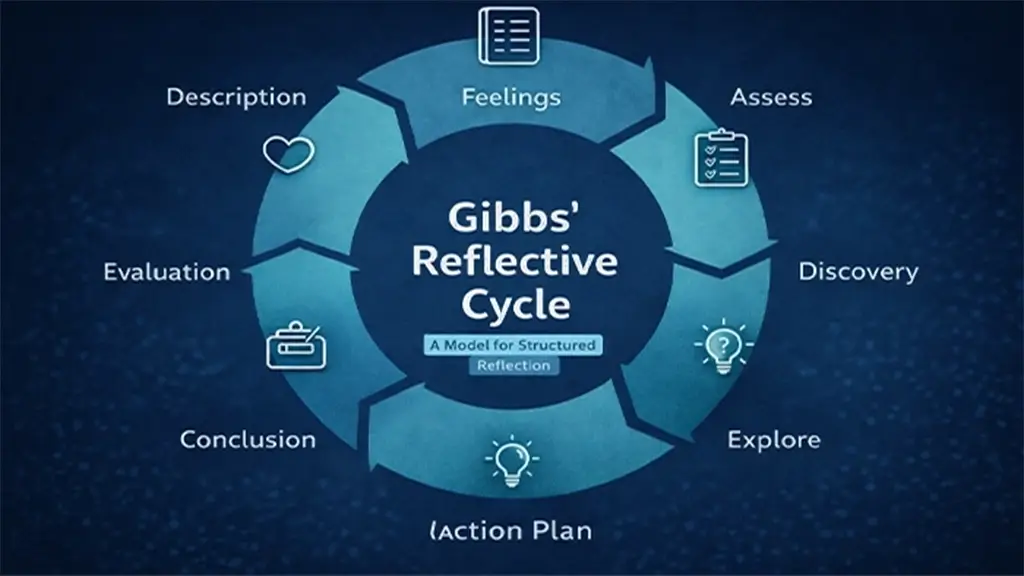
 By
By Reflecting on experiences can help people handle them well in the future. A lot of people discover that they study well from experience
But the problem is lot of people do not reveal their experience, and if they do not willfully think about in what way they can do better next time
Because of that, it is hard for them to study and learn anything at all. This is where Gibbs’s reflection cycle begins
It is the 6-stage framework, developed by Graham Gibbs in 1988. The primary aim of Gibbs reflective cycle is to assist people learn from others
While reflective practice is essential for both personal and professional growth, it enables people to evaluate experiences and learn from successes and errors. And hence boost future performance
The cycle is primarily designed for healthcare students, academic experts, practitioners and corporate trainers
In the next section, I will go into deeper into theGibbs model of reflection.
The 6 Stages of Gibbs’ Reflective Cycle
The 6 stages were developed by Graham Gibbs in the year of 1988, the cycle offer the structure framework. The 6 stages are description, feelings, evaluation, analysis, conclusion and action plan
In order to learn from experiences, it forces a slow, systematic review of events to boost future experience
Here is the quick overview of a Gibbs cycle.
- Description: An explanation of the experience
- Feeling: Thoughts and emotions around the encounter
- Evaluation: Analysis of the event, including both positive and negative aspects
- Analysis: Analysis to understand the circumstances
- Conclusion: It is about your learning and areas for improvement
- Make a plan: To conclude, the action plan for how you would respond to similar circumstances in the future or make any general adjustments you think are crucial
1. Description: What happened
In the first stage, the individual can describe the situation in detail. It is critical to maintain objectivity; ideas, thoughts, emotions, and conclusions can be talked over laterIndividuals should provide a full description of what occurred, who was present, and the steps takenFurther, the goal of this early stage of a Gibbs reflective model is to offer a clear and objective image of the experience to ensure that the individual can ponder and recall it more carefullySome helpful questions are
- What happened
- Who was present
- When and where did this occur
- What actions did the people take
- What was the result
A Description Stage Example
I was helping my mentor with Mr Smith, a 65-year-old patient who had undergone abdominal surgery, on a surgical ward placement. The mentor was called away once I had taken off his bandage. When the doctor came to check the wound, he didn’t wash his hands or apply alcohol gel. In addition, the physician’s long sleeves might have been infected
2. Feelings- What were you thinking and feeling
The 2nd stage of aGibbs model requires an honest analysis of your emotional responses during the experienceBut you need to recall that it is not about focusing on emotions. But about how they influenced your judgments and views, whereas mental wellness has a direct impact on teacher efficiency and professional resilience
- What were you feeling before, during, and after the event
- What do you believe other people were thinking or feeling
- What do you think about the situation now that some time has passed
A feelings stage example
‘’I was nervous and concerned about Mr. Smith’s danger of infection. In addition, I was intimidated by the doctor’s seniority as a student and was hesitant to step in, which made me feel bad about it right away.’
3. Evaluate what is Good and Bad
For the duration of this stage, the experience is factually judged, classifying both its positive and negative parts
This stage ofgibbs cycle of reflection offers a balanced view, accepting both success and areas that need progress. Once you focus wisely, you can easily reveal what went well and what did not
It means you can evaluate the good and bad points. Here is how you can evaluate both good and bad pointers
- What was good and negative about your experience
- What contribution did you make to the situation
- Have your actions had a useful or bad impact? Repeat the inquiry to reflect on the contributions of others
Example of an evaluation stage
Bad: I failed to confront the doctor right away, putting the patient at risk of a surgical site infection
Good: I quickly realised that a process violation had come to pass
4. Analysis – What Sense Can You Make of the Situation
Analysis ofGibbs’ reflective cycle explores “why,” whereas assessment examines “what.” This phase explores the situation’s underlying dynamics, causes, and patterns. It places the experience in the context of a larger body of knowledge. Moreover, it helps you connect the dots through analysis allows you to see the broad frameworks that influence events. That broad vision is enabled from a psychological standpoint.To end, it highlights how your experiences fit into broader and more logical frameworks. Even while you have no influence over those systems, you can learn to anticipate and work with them
- What caused things to go effectively or poorly
- If feasible, how does your experience stack up against scholarly literature
- Would you have reacted differently
- Can you make sense of what happened using any ideas or models
- Are there any elements that could have led to a better result
Analysis Stage Example
This situation shows how difficult it is to confront top employees because of pressure from the hierarchy. Nursing principles of Gibbs reflective cycle analysis, however, state that the patient’s health comes first. Safe practice requirements are certainly refuted by the doctor’s disregard for hand hygiene protocols, which could have a negative impact on patient outcomes
5. Conclusion – What Else Could You Have Done
Following an extensive situation analysis, you can also draw conclusions based on what you have learned. During this stage, you can point out the changes you need to make to the way you handle future events. Here are the key things you need to add in this stage ofGibbs theory of reflection.
- What did you learn from the experience? You can be more precise or more general
- How many things have turned out better for everyone engaged
- What abilities or abilities are required to manage the issue more skillfully
Example of a Conclusion Stage
Even as a student, I should have gently advised the doctor to use the hand sanitiser, looking back. I knew that I had lost the chance to speak up for the patient by staying silent. Finally, keeping clinical standards and showing respect for peers must be balanced
6. Action Plan – What Will You Do Next Time
You must make plans on how to deal with such situations in the future in the final section. Thus, you obtain a variety of abilities to handle diverse settings and reply to these queries of aGibbs reflection.
- In a similar scenario, what would you do in a different way
- How would you use your newly acquired knowledge or abilities
- How can you ensure that you behave differently in the future if you find yourself in a similar situation
- When and how will you acquire the basic abilities
Example of Gibbs reflective cycle, Action plan
I will fiercely make sure that all practitioners adhere to infection control protocols prior to contact in the future. In order to practice gracious, effective methods of challenging senior staff while keeping patient safety in mind, I will talk about this incident with my mentor
Benefits of Using Gibbs’ Reflective Cycle
Here are the unreal pros of using a Gibbs model of reflective practice.
- Increased Self-Awareness: Through thoughts, people learn more about their feelings, ideas, and responses in diverse contexts
- Improved decision-making: By taking into account prior experiences and their effects, reflective practice can result in more informed decision-making
- Ongoing Education- A Gibbs reflective cycle inspires a culture of ongoing education and development on both a personal and professional level
- Problem-Solving Skills: Encouraging people to examine and assess their experiences, it improves problem-solving abilities
- Professional Development: To improve their abilities, adjust to new obstacles, and satisfy the changing demands of their positions, experts employ reflective practice
Limitations of Gibbs’ Reflective Cycle
Despite the fact that there are tons of pros and practical life examples in many fields like Gibbs reflective model nursing, education, and business and management, the cycle still has some drawbacks
In the next section, I will discuss the limitations of the reflection cycle
- Limited External Input: The model may rate too low the status of outside opinions and input because it mostly focuses on reflection
- Self-Motivation: To fully take part in the process, a high level of self-discipline and ambition is needed
- Self-Evaluation Challenge: Giving oneself frank and helpful criticism can be hard and may call for mastering particular self-assessment techniques
Final Verdict – Your Journey to Continuous Growth
The Gibbs’ Reflective Cycle is still a useful and timeless context for ongoing growth on both a personal and professional level.It enables people to turn any experience, whether favourable or difficult, into a meaningful educational opportunity. The secret to accessing its full potential is to interact with its six organised stages consistently, honestly, and deeply. Moreover, it will allow insights to be turned into real, actionable advances
FAQs- Frequently Asked Questions
- What is the Gibbs reflection cycle?
Ans: It is the framework, developed by Graham Gibbs in 1988, in order to assist people from their experiences
- What is the Purpose of Gibbs
Ans: The aim of a Gibbs Cycle is to give people a methodical, six-stage framework for thinking back on experiences, drawing lessons from them, and performing better in the future
- How do you write a Gibbs Reflective Cycle example?
Ans: It is the structure model, it has 6 stages, to use a Gibbs cycle in practice, define the event that happened, what you were thinking, what was good about the situation, analyse the situation, what you have learned, and finally, what action plan you make for the future
- How do you cite Gibbs Reflective Cycle 1988?
Ans: To cite this reflection, use the source such as Gibbs, G. (1988). Learning by Doing: A guide to teaching and learning methods. Further Education Unit. Oxford Polytechnic, Oxford
- Why do nurses use Gibbs Reflective Cycle?
Ans: In order to promote ongoing professional progress, critical thinking, and better patient care, nurses employ the Gibbs Reflective Cycle to methodically organise, evaluate, and learn from clinical experiences. Reflecting on experiences can assist people handle them well in the future. A lot of people discover that they study well from experience.


 Live Chat
Support
Live Chat
Support +44 7933 142807
 info@assignmentmaster.org.uk