 +44 161 381
0000
+44 161 381
0000 info@assignmentmaster.org.uk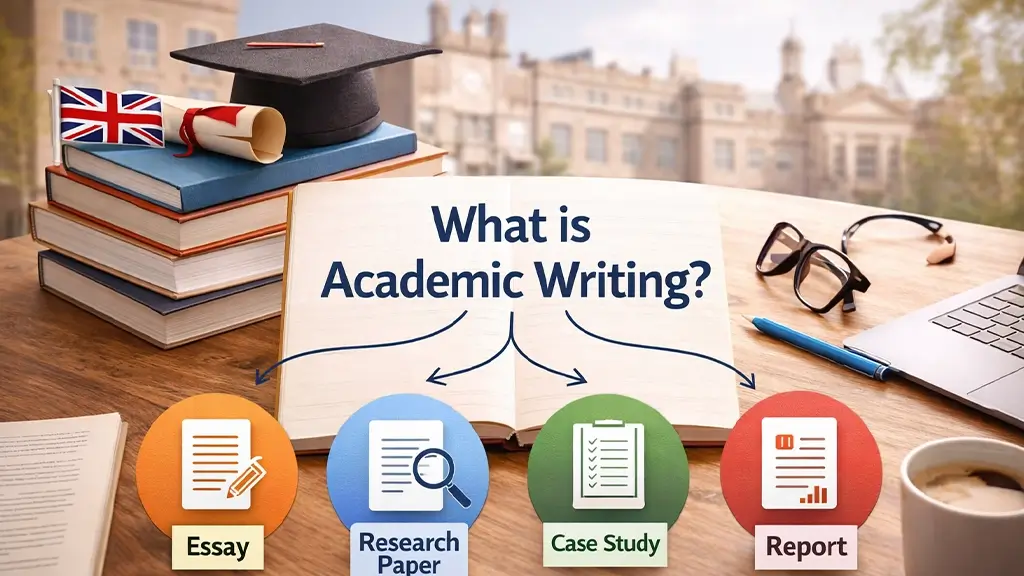
 By
By Whether you are a college or university student, if you are not proficient and skilled in academic writing, then your grades will suffer at some point. This is because many assignments are assigned to students at every academic level that involve academic writing.
Moreover, academic writing allows students to communicate ideas in a clear and structured manner. Also, it follows specific conventions, unlike casual or creative writing.
In certain education systems like the UK, academic writing is considered a complex task due to the high expectations: arguments must be well supported, language must be formal and objective, and structure must be coherent. Moreover, if you learn the art of academic writing, you will be able to communicate your ideas perfectly.
Let’s learn about the different types of academic writing and essential tips, the 7 c’s of academic writing, and the key language features for academic writing.
What is Academic Writing?
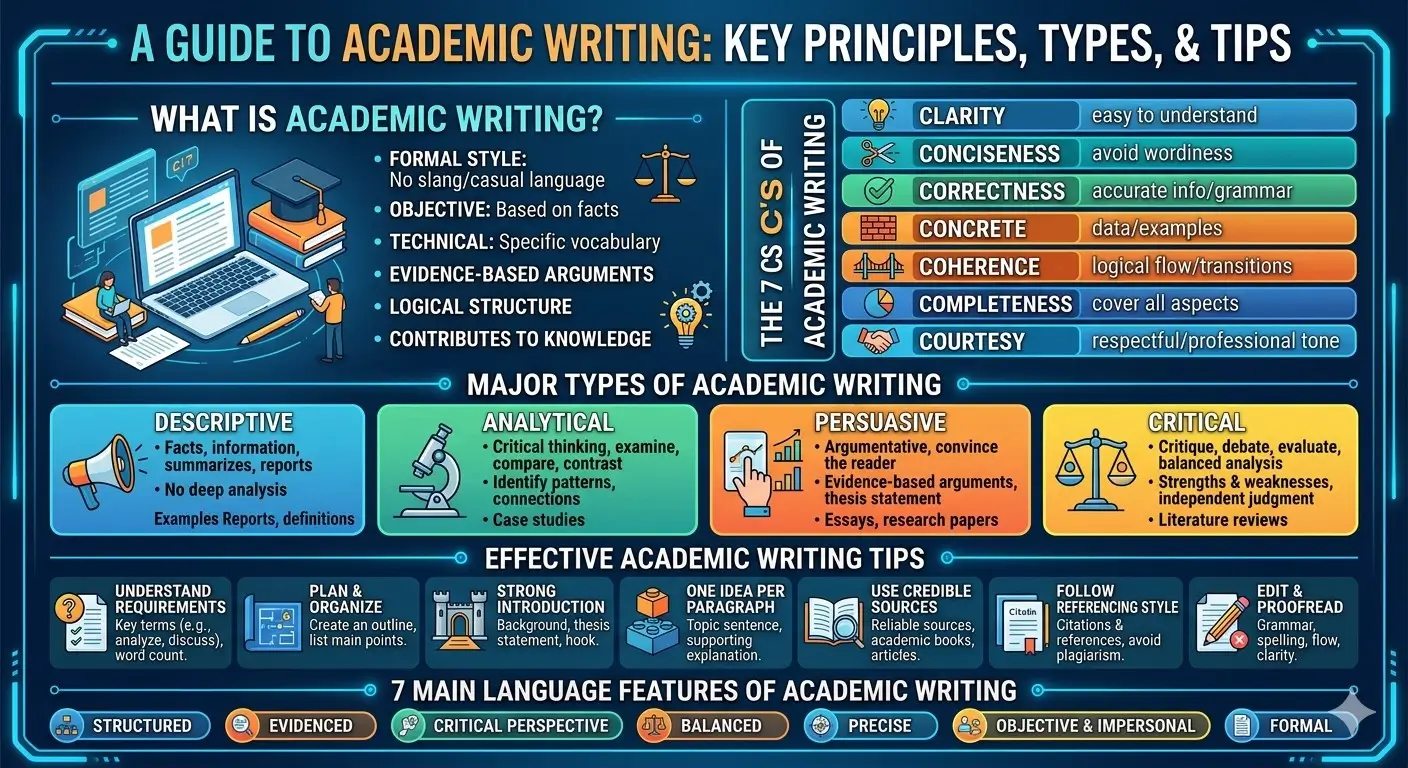
In simple words, academic writing is the writing style used by students, academic professionals, and researchers in their publications and assignments. This formal style of writing is objective(based on facts) and technical( use of specific vocabulary and jargon), and it doesn’t involve casual or informal language.
Depending on the type of assignment or discipline, you will have to learn different styles and structures of academic writing.
Evidence-based arguments, logical structure, formal tone, and clear language characterise academic writing. The main purpose of academic writing is not merely communication, but also analysing ideas, thinking critically, evaluating arguments, and contributing to knowledge.
The difference between non-academic writing and academic writing is that in academic writing, you have to write claims and also support them with credible sources.
What are the major types of Academic Writing?
There are several types of academic writing, and each type has a different purpose and specific language features. However, in some assignments, you may have to use more than one type.
Descriptive writing:
It focuses on describing facts and information. If in the assignment you are asked to identify, define, summarise, or report, then it’s descriptive writing. Some examples are: reports, summaries, or definitions. The main features of descriptive writing are that it involves a simple structure, no in-depth analysis, and focuses on what rather than why.; Moreover, it involves the use of vivid language to create a detailed picture of an object, person, event, or place.
Analytical writing:
If you are asked to analyse, compare, contrast, relate, and examine, then it’s analytical writing. This type of writing demands critical and analytical thinking. It depends on the writer how much he/she wants to be analytical and go in-depth. Identify patterns, similarities, differences, advantages, and disadvantages, etc. It depends on you which aspect of the topic you want to analyse. You may also compare theories or analyse case studies in this writing.; It is characterised by the logical organisation of the ideas, use of evidence, and focus on patterns and connections.
Persuasive writing:
It is also known as argumentative writing. It involves the use of arguments to persuade the reader of a certain perspective or point of view. For each argument, you have to provide evidence or a reference. The examples are essays and research papers. The main features of persuasive writing are: strong thesis statements, evidence-based arguments, and counterarguments.
If you are struggling to develop your argument, then you must read the arguments provided by other researchers, identify justification for your viewpoint, consider various evidence, think about how your viewpoint is different or similar to the viewpoints of other researchers, and break your viewpoint into different aspects or approaches.
Critical writing:;
Critical writing is common at the undergraduate and postgraduate levels. When you are asked to ‘critique’, ‘debate’, ‘disagree’, and ‘evaluate’, it is the critical writing. It involves discussing a topic having at least two viewpoints in your mind, i.e., merits or demerits. Example: literature review or critical essays
The main features of critical writing are balanced analysis, strengths and weaknesses, and independent judgment.
In this writing, you have to provide a summary, then an opinion about it. For example, you can have an alternative approach to it, or you can defend, or identify some problems in it.
Then, depending on your point of view, you can search for evidence. You can connect with an academic writing service if you have no time to craft your assignment.
What are the 7 C’s of academic writing?
The 7 C’s of academic writing are essential principles that ensure effective articulation of ideas and expression.
Clarity
In academic writing, you have to use precise language and avoid ambiguity. You must make sure that when a person reads your writing, he/she can understand what’s written without having to reread the lines.
Conciseness
;You must not use repetitive and unnecessary words.
Correctness
Make sure that you write using accurate information with proper spelling and grammar.
Concrete
You must support the arguments and information with evidence such as data and examples rather than vague points.
Coherence
Then, you must also use transitions to add logical flow and connect the ideas seamlessly. It adds coherence.
Completeness
You must make sure that you cover all aspects of the topic by providing all the necessary information.
Courtesy
You must also maintain a respectful, professional, and unbiased tone even when you disagree with the topic.
What are the 7 main language features of Academic Writing?
- Structured: academic writing is not randomly written. It follows a proper structure of introduction, body, and conclusion. It is important for a logical flow and coherence.
- Evidenced: academic writing relies on examples and data rather than vague and random opinions
- Critical and analytical perspective: In critical or analytical writing, you must move beyond description and add different aspects or viewpoints.
- Balanced: You have to present a nuanced view. Also, avoid adding extreme or subjective language.
- Precise: You must use specific vocabulary and language to convey accurate meaning.
- Objective and impersonal: You must use the third person or passive voice to emphasise results. Avoid emotional evaluative language.
- Formal: It must adhere to the academic tone. Also, avoid contractions or slang.
What are some effective Academic Writing tips?
Understand the requirements
Before you rush to the writing part, make sure that you know what is expected of you in writing. Identify the key terms, such as analyse, discuss, or evaluate, then check the word count and understand the purpose of the writing.
Plan and organise your ideas
Then you must create an outline for the introduction, body, and conclusion. List the main points for each section and arrange ideas coherently.
Write a strong introduction in academic writing
Introduction matters. It sets the tone for the entire paper. It must include background information, a clear thesis statement, etc.
Make sure you cover one idea per paragraph
Each paragraph must follow a simple structure including a topic sentence, supporting evidence, and an explanation.
Use credible academic sources
Then you must support your claim with reliable sources such as academic books, reports, or articles.;
Follow a proper referencing style
Don’t forget to add citations or references. It helps to avoid plagiarism.
Edit and proofread
Check for all types of errors and inconsistencies, such as grammar and spelling errors, sentence structure, flow, and clarity, and fix them.
All in all!
In academic writing, you don’t have to put words into a paper. Instead, it requires structure and organisation of ideas. It is a useful skill that you must master if you want top grades in your university or college. Whether you have to craft an essay, report, or research paper, knowing the art of academic writing will help you structure and organise ideas coherently and craft an impressive write-up.
FAQs:
What are the 5 C’s of academic writing?
A. Clarity, Cogency, Conventionality, Completeness, and Concision.
What is academic writing?
A. Academic writing is a formal style of writing that is objective(based on facts) and technical( use of specific vocabulary and jargon), and it doesn’t involve casual or informal language.
What are the 4 types of writing styles?
A. Persuasive, analytical, descriptive, and critical.
What are the 7 C’s of academic writing?
A. Clarity, Conciseness, Concreteness, Correctness, Consideration, Completeness, and Coherence
What are the 4 types of academic writing?
A. The four primary types of academic writing are descriptive, analytical, persuasive, and critical
What are the 4 C’s of writing?
A. Clarity, Conciseness, Completeness (or Coherence), and Correctness.
What are the 7 types of academic writing?
A. Descriptive, analytical, persuasive, critical, expository, reflective, and narrative.


 Live Chat
Support
Live Chat
Support +44 161 381
0000
+44 161 381
0000 info@assignmentmaster.org.uk