 +44 7933 142807
 info@assignmentmaster.org.uk
 By
By Has your “I” ever whispered to you? Have you ever held conversations with yourself, gazing longingly at the sky? If yes, then the term “reflection” is no stranger to you!
Also, as a nursing student, you know your one small decision can affect a patient. So it is important to learn through reflection.
But here you are, fretting over how to write a reflection. Therefore, keep calm and follow this comprehensive guide on the Driscoll model of reflection. It breaks everything down into three simple questions: what, so what, now what.
Let’s dive in!
Why Reflection Matters
Before you dwell on Driscoll’s model of reflection. First, understand why it is important to reflect as a nursing student.
Imagine you give medication to a patient, but make a small mistake. Then you take a moment to reflect, and you learn from it. So next time, you won’t make the same error.
That is to say, reflection keeps your practice safe and smart. When you take time to think:
- What happened?
- Why did it matter?
- What will you do next?
That is where real learning starts.
In nursing, reflection is not optional. The UK NMC ( Nursing and Midwifery Council) advises reflecting for professional development. So, you can connect your classroom learning with real clinical situations.
But how to reflect? This question takes us to the Driscoll Model of Reflection in Nursing. Move to the next sections of the blog to know all about it!
What is the Driscoll Model of Reflection?
The Driscoll model of reflection is like looking in a mirror. That is to say, it is a structured introspection framework. It was created by John Driscoll to help people learn from experience.
Hence, it is one of the easiest ways to understand reflection as it breaks it into:
- What
- So what
- Now what
Read on to understand these stages of the Driscoll model of reflection.
Stages of the Driscoll Model of Reflection
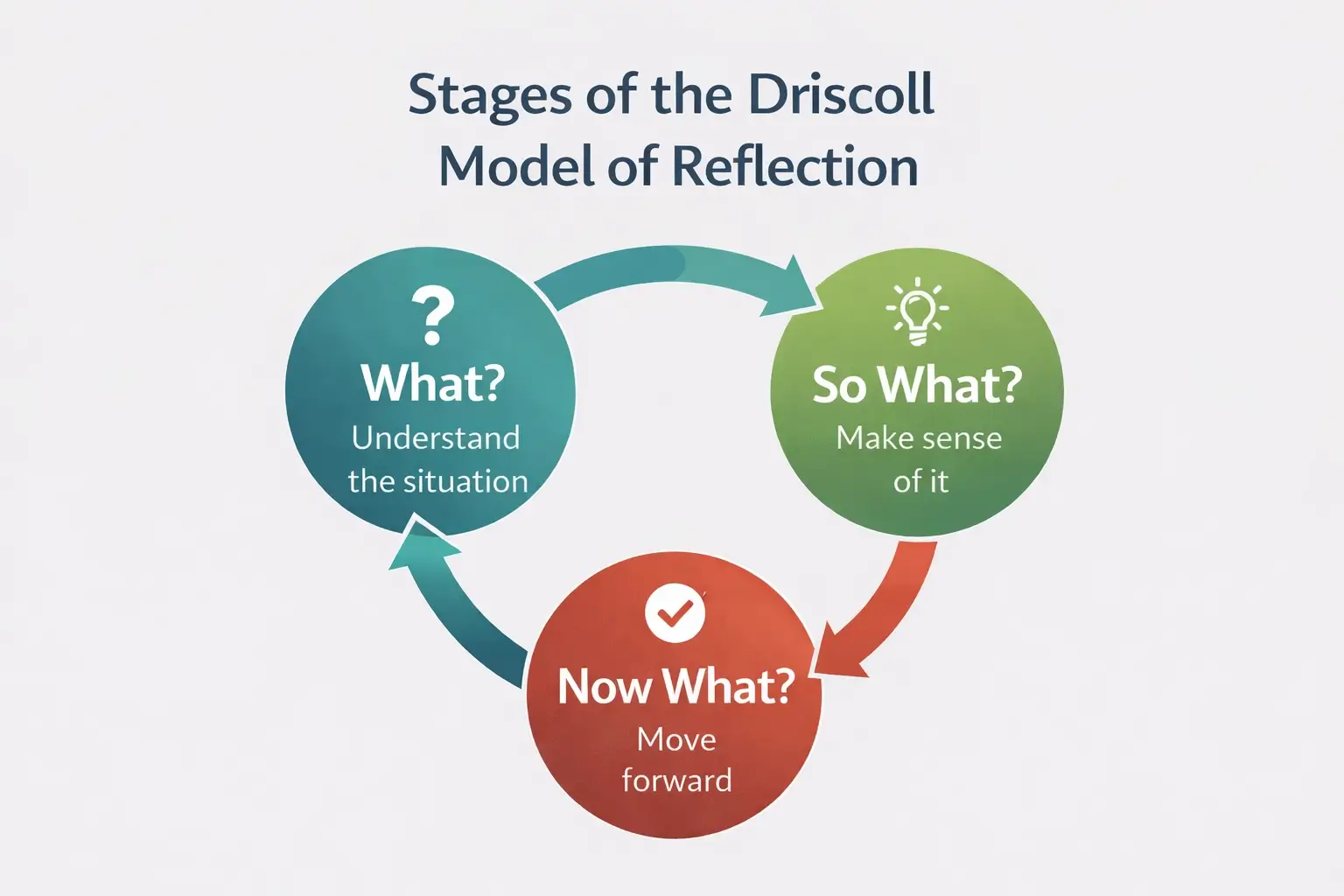
What: Understand the situation
This is the first step of reflection. So, here you describe:
- What happened?
- Who was involved?
- What did you do?
In Driscoll’s What model, there is no deep thinking. All you need is a clear explanation.
So What: Make sense of it
This is where reflection becomes deeper. That is to say, you start to think about:
- How did you feel?
- Why did things happen that way?
- What impact did it have?
This stage is what makes the Driscoll’s reflection model powerful and insightful.
Now What: Move Forward
This is the most important part of reflection, as here you ask:
- What did I learn?
- What will I do next time?
- How can I improve?
Hence, this step turns all your reflection into real growth. But is the Driscoll Model the only way to reflect? No, then which is better? Let’s follow to find out!
Driscoll Model vs Rolfe Reflective Model
There is one more model of reflection that is the Rolfe Reflective Model.
Both of these introspection models use the same three questions. But Driscoll gives more structure. So that makes it easier for students to write assignments.
If you feel confused, the Driscoll’s model of reflection is the better choice. So, let’s learn how to use it.
How to write using the Driscoll Model of Reflection?
Tempted to use big, fancy words? Stop yourself there. To write a strong reflection, you need clear thinking. So, to focus on your experience and thoughts, follow these steps:
Step 1: Understand the situation
Take a moment to pause and try to understand what happened. That is to say, think through each detail of the situation.
The clearer you are about what happened, the better you can understand and learn from it.
Step 2: Use these three questions
Break your reflection into three parts:
- What: Here be factual, not emotional.
- So what? Analyse why it mattered.
- Now what? Explain how this experience will change your future actions.
With this step, your reflection will have a clear structure. So, anyone can understand it.
Step 3: Think deeper
Don’t just describe events, analyse them. So, consider your:
- Feelings
- Actions,
- Reactions.
So, in this step, you can think critically. This helps you gain real insight, instead of writing a mere retelling of a story.
Step 4: Link with theory
To improve your marks, connect your experience with theory or research. This shows your professors that you can relate clinical situations to your studies. For example, you can link nursing procedures to patient care models.
Step 5: Show improvement
End your reflection with learning. In other words, highlight what you have gained from your experience and how you can apply it in the future.
So, remember, reflection is about growth. It shows that you are thinking of change and improvement. But there are some limitations of Driscoll’s Model of Reflection. Read on to understand them.
What are the limitations of Driscoll’s Model of Reflection
Though the Driscoll model of reflection is simple. But it is not perfect as it:
- Feel too basic for deeper analysis
- Depends on how honest your reflection is
- Does not fully explore complex situations
Still, for nursing students, it is one of the easiest models to use.
FAQs
- What is the Driscoll model of reflection?
Ans. It is a simple method of reflection using three questions:
- what
- so what
- now what.
- How do you cite Driscoll’s 2007 model of reflection?
Ans. Driscoll, J. (2007). Practising Clinical Supervision.
- What is the Driscoll theory?
Ans. It explains how structured reflection improves learning from experience.
- What are the 4 reflective models?
Ans. Driscoll, Gibbs, Kolb, and Rolfe’s reflective model.
- What are the key steps in Driscoll’s model?
Ans. What, So What, Now What.
- What is Driscoll’s known for?
Ans. Creating a simple and practical reflection model used in nursing.
Final Words
Attention nursing students!
Good reflection changes how you learn. The Driscoll model of reflection makes that process simple and clear. That is to say, instead of overthinking, it helps you focus on:
- What happened?
- Why does it matter?
- What will you do next?
In simple words, the Driscoll model tells you, “keep your mind over matter!” That is how you can move from confusion to confidence.


 Live Chat
Support
Live Chat
Support +44 7933 142807
 info@assignmentmaster.org.uk