 +44 161 381
0000
+44 161 381
0000 info@assignmentmaster.org.uk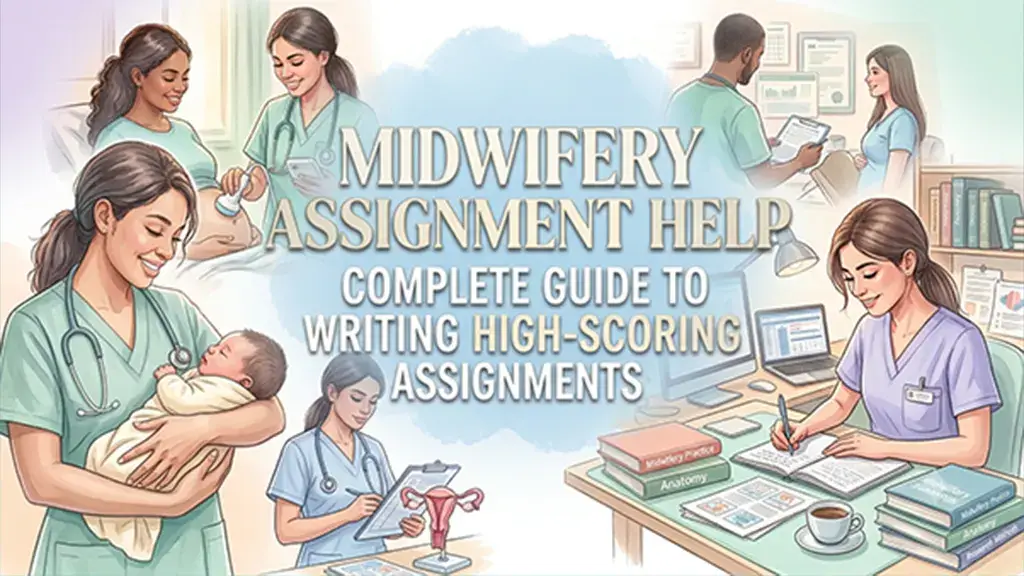
 By
By Have you ever been in a situation where you look at your midwifery assignment and wonder, ‘Where exactly do I begin to ensure my assignment gets high scores?’
Let me tell you that you are not the only one to experience this. In fact, many midwifery students end up feeling overwhelmed when they have to juggle lectures, part-time jobs, clinical placements, assignment deadlines, and exam preparation all at once.
I am completely aware of how demanding your midwifery degree experience can be, as you don’t just have to memorise facts. Instead, you are required to improve your critical analysis, reflect on life-like practice, support each of your arguments with evidence, and present your ideas in a professional academic style. Only these types of answers are considered ‘high-scoring,’ which is why students rush to midwifery assignment help.
I know that it can feel like a huge challenge, but the good news is that writing a high-scoring assignment is a skill that you can easily develop with the right approach and sometimes with professional assistance.
In this post, I have shared everything you need to know about midwifery assignment assistance, its benefits, and you can also learn about different assignment types and how to avoid common mistakes in your midwifery assignment.
Brace yourself and read till the end!
What Is Midwifery Assignment Help?
First things first, you must have your answer to what midwifery student assignment help actually is. Like other students, do you also assume that assistance with midwifery assignments means only asking someone else to complete your assignment? Let me tell you that it is a common misunderstanding.
Since midwifery assignments often require you to do more than just simply describe pregnancy, childbirth, or postnatal care, your instructors expect you to analyse situations, evaluate research findings, and justify every recommendation using reliable academic sources. Now that’s a major challenge that can leave you confused.
This is when reliable midwifery coursework help can become handy for you, as it helps students learn how to:
- Understand assignment questions correctly.
- Plan a logical structure to maintain coherence in your content.
- Find trustworthy research.
- Apply evidence-based practice to your coursework.
- Improve your academic writing tone and vocabulary.
- Reference sources without making citation or referencing style errors.
- Avoid plagiarism in your work.
Most importantly, good guidance from a midwifery assignment writing service can help you, as a student, become an independent learner. This way, you can develop skills that benefit you throughout university and your future career.
Why Are Midwifery Assignments Challenging?
Midwifery is among the most rewarding healthcare professions, which is why it is one of the most demanding courses. Common reasons why you may feel that midwifery assignments are challenging include understanding the complex topics, meeting the UK’s writing standards, and balancing NHS placements and coursework, among others.
Balancing Clinical Placements Makes it Difficult to Focus on Assignments
A major challenge is finding enough time, as you have to juggle classroom lectures, clinical placements, and practical assessments, along with exams. Honestly, arranging time from your busy routine to write thousands of words for your assignments can be quite bothersome and difficult.
Not Understanding Medical Topics Makes Assignments Complex
As you know, midwifery programs require you to study various topics, and some of them involve complicated medical terminology, which may take time for you to understand.
Throughout your degree, you’ll study:
- Maternal physiology.
- Neonatal health.
- Antenatal care.
- Labour and birth.
- Postnatal care.
- Infant feeding.
- Pharmacology.
- Mental health.
- Woman-centred care.
All these require a strong grasp of your subject, and you will also need polished academic skills.
Meeting UK Academic Writing Standards Is Quite Challenging
You must understand that your academic coursework will be written differently from everyday writing. Many students struggle because they fail to analyse information and only describe it.
Remember that your university professors expect your assignments to demonstrate:
- Critical thinking.
- Logical structure.
- Professional language.
- Balanced discussion.
- Evidence-based arguments.
- Accurate referencing.
While learning this style, you will require practice, patience, and feedback.
Finding Reliable Evidence Becomes Difficult
You can find thousands of articles about pregnancy and childbirth on the internet, but you must understand that not all of them are trustworthy and authentic enough to use as evidence in your work.
Universities expect you to use reliable sources such as:
- CINAHL.
- PubMed.
- Cochrane Library.
- Google Scholar.
- NICE Guidelines.
- NHS publications.
- Nursing and Midwifery Council (NMC) guidance.
Finding relevant evidence may take up much of your time, especially when you are unfamiliar with academic databases.
Managing Pressure and Deadlines Creates Stress
As a midwifery or healthcare student, you already know that every semester brings new responsibilities. You might have to manage multiple assignments at the same time. And no, this doesn’t end here. Along with these, students also have to manage exam preparations and attend placements.
Amidst this pressure, many students rush their work, which leads to grammar mistakes and other errors, including weak arguments and poor referencing. By developing effective habits and using professional assistance, you can reduce stress and improve your assignment’s overall quality.
| CTA: Struggling with similar issues that make your midwifery assignments difficult? Don’t worry, our midwifery assignment help services are what you need to overcome all hurdles in your midwifery assignments. Connect with us today! |
Common Types of Midwifery Assignments
When you are all prepared for your assignments, you might be wondering, what can my midwifery assignments be based on? Let me make it clear to you that each of your assignments assesses your information and skills differently.
Among the common types, you should know about essays, case studies, reflective assignments, research projects, and dissertations.
1. Essays
Essays are probably the most common assessment throughout a midwifery degree. They require students to explore a topic in depth while presenting a balanced, evidence-based discussion.
Rather than simply describing facts, you should ensure that your essay demonstrates your ability to evaluate research and explain why certain approaches improve patient outcomes.
2. Case Studies
Case studies allow you to apply your theoretical knowledge to complex, reality-based clinical situations. You may receive details about a pregnant woman experiencing complications, after which you will be required to recommend appropriate care throughout pregnancy, labour, and the postnatal period.
You must remember that you have to ensure that your case study is relevant and explains every decision using current clinical guidelines rather than your personal opinion.
3. Reflective Assignments
With a reflective assignment, you are encouraged to think carefully about your clinical placements and other experiences. You can improve your professional development, as it requires you to explain what you learn, how you respond to challenges, and what you would improve in future practice.
For you, you will have to include:
- What occurred.
- Why did it happen?
- What did you learn?
- How does research support your learning?
- What would you improve in future practice?
You must remember that your reflective assignment can earn good grades if it demonstrates your personal growth, professional accountability, and continuous improvement.
4. Research Projects
Research projects require you to investigate a healthcare concern using the existing evidence. For your midwifery project, it could include the following :
- Maternal obesity.
- Preventing postpartum haemorrhage.
- Supporting women with complex pregnancies.
- Enhancing communication during labour.
You will need to search academic databases, compare different findings, find out gaps in your current knowledge, and discuss how clinical practice can be improved based on your evidence.
5. Dissertations
It wouldn’t be wrong to say that dissertations are often the most demanding assignment type in midwifery or any other degree. Unlike other assignments, a dissertation requires you to conduct independent planning, extensive research, and detailed critical analysis.
Since students have to spend several months reviewing literature, organising chapters, and presenting evidence logically, many of them seek to simplify this process.
How to Write a High-Scoring Midwifery Assignment?
Don’t know what it actually takes to write a top-grade midwifery assignment? Let me help you. For that, you will need to understand your assignment briefly, support your arguments with credible evidence, and showcase your critical thinking skills in your writing.
You can follow these tips to :
1. Understand the Assignment Brief Thoroughly
Before you begin writing, you must read and understand your assignment’s brief carefully, or else you can lose marks. Many students face deductions because they fail to look for the important instruction words, such as:
- Compare.
- Evaluate.
- Analyse.
- Discuss.
- Justify
- Critically examine.
Remember that you will have to follow a different writing approach for each of these instructions. If anything seems confusing, you should ask your lecturer for clarification or consult professional help to ensure that you’re not making.
2. Conduct High-Quality Research
Once you understand your assignment’s brief, you have to gather evidence from globally trusted academic sources. For that, make sure that you use peer-reviewed journals, official publications from the UK government, university library databases, and other UK-recognised healthcare guidelines. Also, don’t forget to organise your research materials.
3. Create a Clear Assignment Structure
This is very important.
You have to ensure that all your content and arguments are composed clearly. For that, you have to include:
- A clear, precise introduction that explains your assignment’s purpose and briefly highlights what your assignment will discuss.
- Prepare your assignment’s main body by presenting each of your arguments in a logical, coherent order and ensure to support your claims with current evidence.
- End your assignment with the conclusion that summarises your key findings.
By taking care of these things in your structure, you can be confident that your assignment explains your points without creating confusion.
4. Write Using Your Critical Thinking Instead of Describing
Do you believe that longer explanations automatically earn good points? Unfortunately, that’s not true. Instead, for a high-scoring midwifery assignment, you have to move forward from describing your information and focus on analysing evidence, comparing research studies, and also explaining why particular approaches are effective according to your key findings.
For a better critical analysis, you can think, ‘What does this mean for midwifery practice?’ whenever you are including evidence. It can help you answer your question more effectively.
5. Edit, Proofread, and Reference Carefully
Last but not least, submit your content after carefully checking it and ensuring that you have fixed all the grammatical mistakes, awkward sentences, missing references, repeated ideas, and spelling errors.
However, if you want to guarantee that you’re not leaving any room for mark deductions, I suggest that you seek professional help so that you can fix these basic mistakes, along with tackling the referencing style, plagiarism, and in-text citation errors.
| CTA:
Still unsure how to write a high-scoring assignment for your midwifery program? Let our experts provide you with professional, industry-backed academic writing help so that you can write a midwifery assignment that earns good grades and improves your overall academic performance. Contact our professionals today! |
Evidence-Based Practice in Midwifery Writing
courses means that you have to present every recommendation by supporting it through reliable research rather than including your personal opinions. Here’s how you can do it effectively:
Use Current and Reliable Sources
You are required to use up-to-date sources so that you understand modern midwifery practice. Moreover, you have to showcase that you can apply the latest recommendations for effective patient care.
Instead of using outdated textbooks, you should support your work with evidence from journal articles, NHS publications, NICE guidelines, and peer-reviewed sources.
Connect Evidence to Clinical Practice
You should keep in mind that finding research materials is only half the job. For a high-scoring assignment, you have to explain how that evidence can influence real-life scenarios while you make clinical decisions. When you show these practical connections, it demonstrates your critical thinking.
Compare Different Perspectives
Have you noticed how some studies support one intervention while others recommend an alternative approach to a particular concern?
That’s why university students like you are advised to compare different viewpoints, discuss the quality of your evidence, and explain which recommendations appear most convincing. All these can help you strengthen your critical analysis.
Think About Patient-Centred Care
While discussing midwifery care, you should also consider the individual needs, cultural background, personal preferences, informed choices, and emotional wellbeing of women. When you demonstrate this balanced approach, you can easily reflect the values that are promoted by the NHS, NICE, and the Nursing and Midwifery Council.
Common Mistakes Students Should Avoid
Do you ever think, ‘Why do even the hardworking students sometimes lose marks on their midwifery assignments?’
That’s because they usually fail to avoid errors, such as using unreliable sources, overlooking critical analysis, inefficient time management, and other mistakes, which impact their final grades.
Poor Time Management
Many students leave their assignments to complete only a few days before the final deadline.
Keep in mind that leaving your assignments to complete until the final few days can lead you to rush through your research and writing process, which may result in weak arguments, poorly written content, and unnecessary stress.
For your complex assignments, you should break them into smaller tasks. For instance:
- Assign different timeframes for reading the assignment brief, collecting research materials, and creating an outline.
- Also, you should break your entire content-writing phase into writing dedicated sections at particular times.
- Next, set a specific time for editing and proofreading.
Forgetting to Proofread
You should always remember that grammatical mistakes, referencing errors, or other proofreading mistakes can reduce the overall quality of your assignment and increase your chances of deductions.
Therefore, you should always check your content thoroughly before submitting. You can also use proofreading techniques, such as reading aloud, to eliminate structural mistakes and awkward phrases.
Using Weak or Unreliable Sources
You should understand that even though the internet contains plenty of information related to health topics, not every piece of that information is suitable for your academic work.
For instance, opinion-based write-ups, blogs, and unauthorised websites don’t usually provide the level of authentic evidence you need for your university assignments. That’s why you should use trusted sources that make your arguments stronger and improve the overall quality of your assignment.
Referencing Requirements for Your Midwifery Assignments
Just as understanding your assignment’s structure is important, referencing is also essential. That’s because it helps you show that trusted evidence sources support your work and that you give credit to the original authors.
- Carefully follow your university’s preferred referencing style, such as Harvard or the APA.
- Ensure that you include in-text citations whenever you are using another author’s ideas, direct quotations, or research findings.
- Also, include a complete reference list at the end of your assignment and confirm that you have included accurate author names, publication dates, titles, journal names, and page numbers.
- Make sure you avoid plagiarism by writing your notes in your own words and referencing every source correctly.
- Use referencing tools and software carefully to save time by organising your sources automatically.
Benefits of Professional Midwifery Assignment Help
There is a misconception that only the students who are incapable of doing their assignments on their own seek guidance. If you think the same, let me clear this misconception for you.
By using professional assignment help for your midwifery studies or any other program, you can manage your workload more efficiently, improve your understanding for better exam preparation, enhance your academic writing skills, and improve your overall academic performance.
Here is what I am talking about:
- With good academic support, you can easily understand difficult concepts, and you can also learn how to approach your future assignments without any help. Over time, this support can help you improve your confidence and academic writing skills.
- By using midwifery coursework help, you can save time by receiving guidance on your research process, planning, or referencing.
- It doesn’t matter if you are a midwifery student, a nursing student, or enrolled in any other healthcare field. You are required to juggle multiple responsibilities at once, which can lead to stress. With expert assistance, you can manage your coursework deadlines with ease.
- Moreover, you can use professional midwifery assignment help to improve your arguments, critical analysis, and academic vocabulary related to your specific subject and boost your overall grades.
Frequently Asked Questions
1. Is it legal to seek help with my midwifery assignment in the UK?
Yes, midwifery assignment help in the UK is legal. However, you should ensure that you maintain academic integrity by using the professional support only for guidance rather than relying on them to submit work that is written by someone else.
2. Can I improve my grades with assignment guidance?
Yes, with expert guidance, you can organise your ideas, understand the assignment marking criteria to write accordingly, improve your critical analysis, and also avoid common mistakes. Together, these can lead to better assignment grades.
3. How important is proofreading?
Proofreading is extremely important for your midwifery assignment, as you can reduce the risk of mark deductions by fixing grammatical mistakes, referencing issues, or any other errors.
4. What makes an assignment high-scoring?
You can write a high-scoring assignment, you can efficiently demonstrate your critical thinking, organise your content in a clear structure, ensure accurate referencing, and include meaningful evidence that connects your research with midwifery practice.
The Final Take
At first, writing a high-scoring midwifery assignment may seem like a challenge to you, but you can make it easily manageable when you seek reliable academic support and understand what the lecturers expect from you.
Whenever you feel overwhelmed throughout your assignment, I suggest that you seek midwifery assignment help that can help you conduct efficient research, improve your references, boost your critical thinking skills, and earn good assignment grades that contribute to your better overall academic performance throughout your midwifery studies.


 Live Chat
Support
Live Chat
Support +44 161 381
0000
+44 161 381
0000 info@assignmentmaster.org.uk