 +44 161 381
0000
+44 161 381
0000 info@assignmentmaster.org.uk
 By
By | Did You Know?
According to UK workforce reports by Skills for Care, over 1.5 million individuals are employed within adult social care. This reflects the sustained demand for trained professionals. |
If you are a disability support worker and need a solid resume, this blog is for you. A professional support work resume shows how quickly employers recognise a candidate’s suitability for care roles across the UK.
Moreover, recruiters assess compassion, safeguarding awareness, documentation ability, and communication strengths within seconds.
That is why you need to have a picture-perfect resume. From strong formatting, targeted keywords, and measurable achievements, these are key factors that help you create a competitive profile aligned with employer expectations.
It also helps candidates present responsibilities clearly when applying for disability care roles, community support positions, or residential care services.
Let’s discover how we can create a skill-selling resume in no time.
Why is a Career Resume Important for the Support Worker?
| NHS workforce insights confirm continued recruitment within community and disability support roles. |
Demand for trained care professionals continues across the UK health and social care sector. A targeted support worker resume communicates capability and commitment in environments where safety and responsibility remain priorities. Moreover;
- Employers evaluate candidates based on experience, certifications, and evidence of independence support delivered to individuals with disabilities.
- Additionally, a strong support worker job description CV shows daily responsibilities and professional conduct.
- Also, hiring managers prefer structured applications over generic documents because they showcase practical readiness.
- Having a tailored support worker CV reflects communication, ability, empathy and safeguarding awareness.
- Another reason why the CV is so essential is that it supports your shortlisting decisions by aligning the achievements with the real workplace expectations.
Just make sure that your CV for disability support workers must be able to present accurate care duties, risk management practices and collaboration with families.
How to Build a Strong Disability Support Worker CV Structure?
To build a strong support worker structure, make sure your CV is person-centric. Also, having a strong layout can make a big difference.
The core principles for the support team include:
- Personal profile
- Core competencies and support worker skills
- Work experiences that align with your career
- Education and certifications
- References
Using a proper support worker CV structure can increase your chances of passing the Applicant Tracking System and make sure that you can stand out among other professionals.
How to Write a Resume for a Disability Support Worker?
To write an effective resume as a disability support worker, you need to follow tips like:
- Professional Summary
- Key Skills Section
- Work Experiences
- Education and Certifications
- Keyword Optimisation
- Follow Proper Format
Following these tips is very important if you want to stand out in the job market.
Come on! Let’s have a look at them in detail.
Professional Summary
The summary introduces experience, compassion and reliability. Moreover, having a refined support worker CV sample can help you present your achievement such as improved client independence, accurate documentation and strong teamwork.
Additionally, employers prefer outcome-driven statements because they show measurable contributions.
While writing, make sure to show that you are aware of the safeguarding standards and healthcare communication.
Here is one of the Support Worker CV Examples to help you understand how to write a professional summary:
“Dedicated support worker with 4+ years of experience delivering personalised care to individuals with physical and learning disabilities with proven ability to implement care plans, support mobility, and collaborate with multidisciplinary teams. Recognised for empathy, professionalism, and consistent safeguarding compliance in high-responsibility care settings.”
Key Skills Sections
You need to show the employers that you have the skills needed to thrive as a disability support worker.
Moreover, use the bulleted list to make this section scannable. Ensure to add both hard and soft skills to your work.
Here are the core skills that you need to have:
Hard Skills:
- First Aid/CPR
- Medication Administration
- Individualized Support Plans (ISP)
- Personal Care (bathing, dressing)
- Mobility Aid Support (hoists, wheelchairs)
- Behavior Support
- NDIS Knowledge.
Soft Skills:
- Patience
- Communication
- Decision-Making
- Empathy
- Adaptability
- Time Management
Always remember the employees reviewing the Disability Support Worker CV consider those employees who possess these skills.
Work Experiences
Your work experience should focus on the achievements you have gained over the years, not on your job title.
Moreover, you should include:
- Daily Documented Progress
- Behaviour Changes
- Health Updates
- Personal Experiences.
Additionally, use the action verbs like Developed, Demonstrated, Facilitated, Supported, etc.
Instead of saying:
“I helped clients with their daily tasks.”
You should say:
“Assisted clients with daily living activities, improving independence, and quality of life through personalized support plans. Thus, this resulted in a 20% increase in daily activity participation.”
Education and Certifications
Education can strengthen your credibility in care roles.
Therefore, to create a structured CV for a support worker, you should include the relevant education including:
- Bachelor’s in nursing
- First Aid Courses
- Manual Handling Certifications
- Safeguard training.
Also, those who have NVQ qualifications in their CV, it can enhance their chances of getting the job.
Additionally, continuous learning is essential. It supports career progression. In fact, many UK employers prioritise candidates who engage in ongoing training aligned with care regulations and patient safety requirements. This shows professional commitment and adaptability in healthcare environments.
Here are some certifications that can boost your chances:
- First Aid CPR Certification. Just make sure it is current.
- Certificate III/IV in Individual Support. (Disability or Aged Care)
- NDIS Worker Screening Check
- Police Check
- Valid Driver’s License
Keyword Optimisation
Recruitment managers often use the filter applications or ATS using relevant keywords to track the right CVs. Hence, integrating such terms can improve the visibility and your selection chances.
Here are some important phrases:
- Support Worker Job Description CV
- Disability Support Worker
- CV support worker.
Moreover, having a well-optimized support worker resume that aligns with the job description can improve the employer recognition.
Choose the Right Format Structure
Formatting also matters when you are creating a resume for the disability support worker. Here is what you need to do:
- Make sure to use the reverse chronological format, which is the most recent job first as it is preferred by the recruiters to see your recent experiences.
- Keep it to 1-2 pages maximum.
- Use a clean, professional font. Arial, Times New Roman, or Calibri works the best. You should also define the headings in bold.
- Save your resume as a PDF to ensure formatting remains intact and name it. For example: “Firstname-Lastname-Support-Worker-CV”.
A Pro Tip: If you are struggling to create your disability support worker resume, consider seeking guidance from the Healthcare Assignment Help. They have professionals who can help you craft a solid CV.
Practical Writing Tips for a Support Worker Resume
To make sure that your support worker resume is relevant and meets the employer’s expectations, you should:
- Maintain clarity and relevance as it can shape the employer’s perception.
- Also, the support worker CV sample should prioritize practical duties
- Follow the correct format to improve the readability.
- Demonstrate professionalism.
- Make sure to use active language, concise bullet points and measurable achievements.
Remember that recruiters prefer documents that reflect accountability, empathy and teamwork.
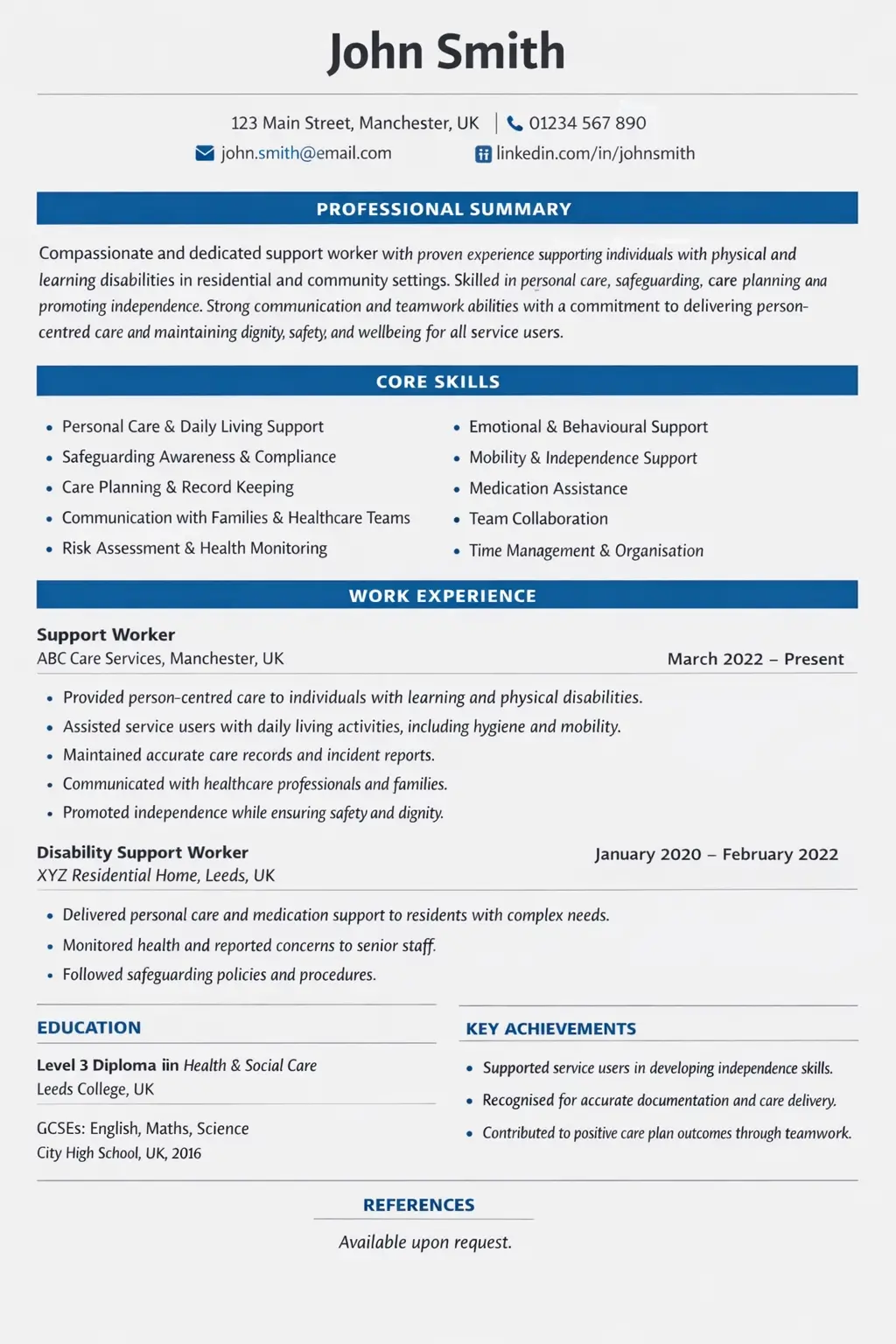
Disability Support Worker Example
FAQs
- How to write a resume for a disability support worker?
To write a resume, you should focus on duties, safeguarding awareness, communication skills, and measurable outcomes aligned with care roles. Moreover, make sure to use a structured format and include certifications.
- How to write a resume with a disability?
In this, you should highlight strengths, achievements, adaptability, and professional experience relevant to care responsibilities.
- What are 5 good skills to put on a resume?
The five good skills to put on a resume include: Communication, empathy, teamwork, organisation, and problem solving.
- What are the skills of a disability support worker?
The skills of the disability support worker include care planning, emotional support, safeguarding awareness, documentation, and collaboration with healthcare teams.
- What are the 5 P’s of a resume?
The five Ps of a resume include presentation, professionalism, precision, personalisation, and performance evidence.
- What skills impress employers most?
The skills that can impress employers are reliability, compassion, accountability, safeguarding knowledge, and communication.
- What are the strengths of a disability support worker?
The strengths of disability support work include empathy, resilience, patience, adaptability, and dedication to independence support.
- What are typical DSP job responsibilities?
They include: Personal care assistance, health monitoring, documentation, safeguarding compliance, and emotional support.
- What are 5 professional skills examples?
Leadership, communication, teamwork, organisation, and critical thinking.
- What qualities make a good DSP?
The qualities that can make you a good DSP include respect, responsibility, patience, empathy, and strong communication.
- What are the 5 key duties of a support worker?
The five duties of a support worker include personal care, independence support, documentation, safeguarding, and collaboration with families.
Wrap Up!
Having a well-structured support worker resume can strengthen your employment opportunities across the UK care sector.
While creating, you need to follow clear formatting, include keywords, back your resume with real-world examples and add relevant certifications to get recruiters’ attention.
Moreover, remember employers do prioritize empathy, safeguarding awareness, and practical care experience.
Follow the proper steps and make sure to stand out among other candidates.


 Live Chat
Support
Live Chat
Support +44 161 381
0000
+44 161 381
0000 info@assignmentmaster.org.uk