 +44 161 381
0000
+44 161 381
0000 info@assignmentmaster.org.uk
 By
By | “Quantitative data analysis methods are essential for a variety of research activities. These tools facilitate the findings of trends, patterns, and connections with data sets”. |
Once expressing hypotheses, testing, theories, and conclusions, these calculable tools are effective.
In order to grasp the numbers well and complex data, apply and use these measurable tools.
These tools support obtaining valuable insights for learners. And thus help them obtain better decision-making.
On the other hand, these quantitative data analysis tools strike fear into most learners in the UK.
But it’s not rocket science; learners can easily grasp it. It is a tricky topic, full of scary lingo, such as median, modes, and regression.
After studying this topic, they suddenly realize they paid better attention in the math class.
The best news for you whereas this topic is a huge one, but can be easily grasped even if you are not good at math.
In the next section, I will walk you through and break down quantitative data analysis into simple, bite-sized chunks.
So, you can easily approach your research.
What Is Quantitative Data Analysis?

Although it sounds fancy, quantitative data analysis is only the examination of numerical data.
On the country information that is readily “converted” into algebraic values without losing its meaning.
For instance, Gender, ethnicity, and native language are examples of category-based variables that might be “converted” into numbers without losing their meaning; for instance, English could equal 1, French 2, etc.
In contrast, qualitative data analysis focuses on words, phrases, and concepts that are difficult to quantify.
Why Is Quantitative Data Analysis Vital?
Data analysis for the measurable data is vital, since it changes new numbers into helpful insights.
There are key reasons why it is essential for students.
- Inform decision making– It supports unbiased assistance to support strategies to ample of businesses such as business, economics, healthcare, and research.
- Testing hypothesis– It makes sure the choices are backed with the help of data, rather than by molds.
- Classify trends and patterns– This tool has the ability to classify any trend and pattern, such as consumer behavior, market movements, or operational richness.
Quantitative Data Vs Qualitative Data: What is the difference
Quantitative data analysis is an effective tool. It is unable to provide your study context; this is where qualitative analysis comes in.
Another popular research technique that focuses on gathering and examining non-numerical data is qualitative analysis.
To better grasp experiences, lookouts, and motives, use text, photos, or audio recordings.
This table outlines the main merits of quantitative data analysis:
| Research method | Quantitative data | Qualitative research |
|---|---|---|
| Types of data | Numbers, data, and percentages | Usually used text, images, videos, and non-statistical |
| Point of view | This data is more objective and less biased | It is more subjective since it might be affected by the researcher’s analysis |
| Data collection | This data usually comprises closed-ended questions | It covers open-ended questions |
| Focus | What and how much | Why and How |
| Best use case | Measure trends, compare groups, and test | Grasping user experience, travel consumers are inspired and look for new ideas |
What Is the Aim of Quantitative Data?
There are 3 main uses for quantitative analysis.
- First of all, it is used to quantify group changes. For instance, the popularity of certain brands or hues of apparel.
- Second, it’s used to assess correlations among variables. Consider the link between voting turnout and weather temperature.
- Thirdly, it is used for hard scientific testing of theories. For instance, a theory on the effects of a certain vaccination.
Once more, this is in contrast to qualitative analysis, which may be used to examine how individuals feel and perceive a situation or occurrence.
Put otherwise, things that are not quantifiable.
Some Other Quantitative Analysis Methods and Approaches
Once you perform this tool, here are some extra methods that can help uncover deep insights.
1. Data mining
This method supports an algorithm as a means to detect hidden patterns, links, and correlations with huge data sets, and as well supporting more precise forecasts.
2. Experimental design
Once you create the controlled setting, researchers and businesses can easily test a hypothesis.
And thus they establish cause-and-effect links among variables.
3. Data visualization
Once you turn raw data into charts and graphs, create complex data, and then simplify it into simpler on. After that, it underlines trends and as well patterns in just blink of an eye.
Note:
While you are taking GCSES in the UK, and need any help with an essay or report. In that case, do not be afraid to take support from good GCSE Assignment Help Services in UK.
These services usually operate with a certified and skilled team of writers. All writers are GCSE subject matter experts; they will offer you deep knowledge.
Also, they will offer you key insights, and you will surely write good GCSE essays. So, reach out to them without wasting any time.
Perks of Using Quantitative Data Analysis
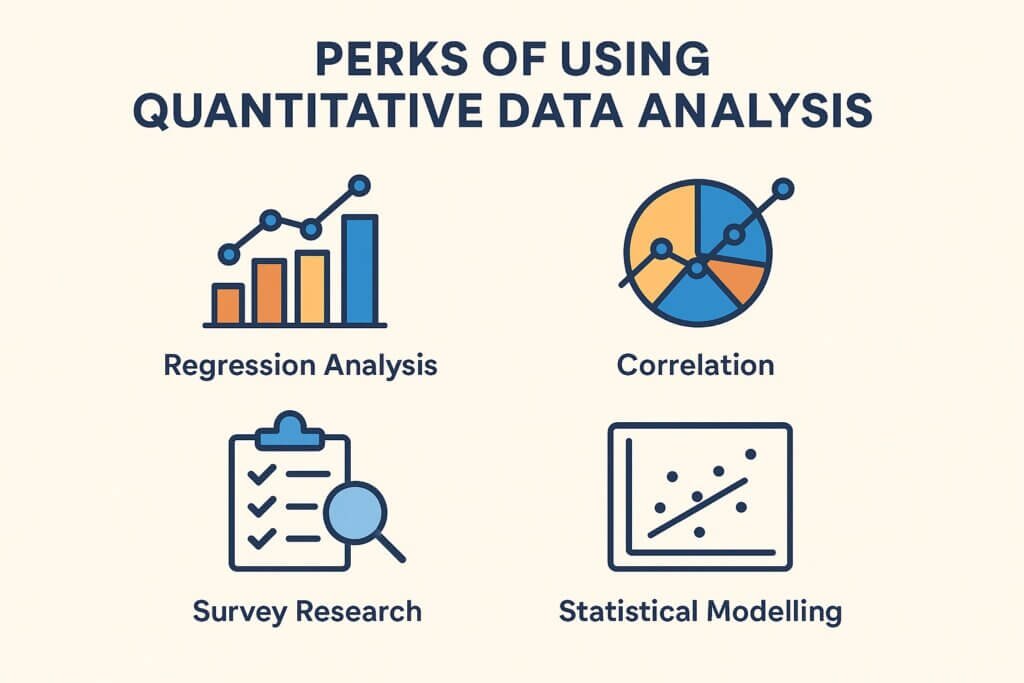
Here are the big reasons and key perks of using quantitative data analysis.
1. Make decisions with trust
Firstly, you can be sure that your choices will be backed by data-driven insights when you use quantitative data analysis.
For instance, you’ll feel poised when you approve the designer if you do a concept testing poll to find out how people feel about a new logo design, and 92% of respondents say it’s “very good.”
On the other hand, you are less likely to make the incorrect choice since you are more reliant on facts and less on intuition.
As a result, gaining support from backers and team members for your upcoming project will also be much simpler.
2. Cut expenses
You can find ways to cut spending by doing the maths. For instance, you may choose to limit your losses and move your budget if an advertising campaign has lower-than-average click-through rates.
In the same way, you can find that you’re getting very low return on outlay from a certain social media channel by probing e-commerce indicators.
For instance, website traffic by source. In that case, you might decide to reduce your outflow in that area.
3. Customize the user interface
You can gain insight into your consumers’ demographics, the page elements they interact with on your website.
Also, the places where they leave off or convert by using quantitative data analysis to map the customer journey.
You may as well better customize your product, message, or website using these insights.
To target certain user personas or target groups with advertisements, emails, and website content.
4. Decrease the subjective bias
Do you know if numbers remove the personal bias and notions from the equations? While qualitative data might be rich in detail.
Still, it is very simple to allow yourself personal interpretations and thus color the results.
On the other hand, quantitative data is greatly structured, and it decreases the risk of bias.
For instance, in interviews few users might tell you they love this new feature. On the contrary, the analysis shows there is low engagement, and thus, numbers tell a different story.
As a result, once you combine both of the research methods, you can easily create info choices based on real user patterns.
These results do not just occur on a personal basis, norms, or statements.
Key Steps to Effective Quantitative Data Analysis
Quantitative data analysis sounds scarier, but then it is not once you grab more details about it.
Also, once you learn in-depth, step by step. Below are the key steps of doing a helpful, calculable data analysis.
1. Collect data
First of all, before you can actually perform a quantitative data analysis, you need to begin with data to analyze.
This entails carrying out quantitative research and gathering numerical data from a variety of sources, such as:
- Analysis of websites
- Opinions from resources such as session records or heat maps
- Surveys and online feedback widgets are examples of surveys.
- Chats or focus groups
Just make sure that your survey questions are closed-ended, giving defendants a limited number of options to choose from, rather than open-ended, allowing for clear answers.
2. Clean data
Now, in this section, after you gather the data then you need to clean it up. For that, you need to look over your results in order to find mistakes, duplicates, and lapses.
But then you need to pay extra attention to outliers. While these outliers are data points and they differ hugely from the remainder of the data.
As a result, they will skew your outcomes if you do not remove or decrease them. Once you take your time and clean the data, you will surely make sure your data is accurate, consistent.
And hence it will be relevant before you can analyze it.
3. Analyze and interpret data
Your data has now been cleaned up and prepared for the big event.
In this stage, the numbers are crunched using math and statistics methods to identify patterns and trends.
There Are Two Primary Areas of Quantitative Data Analysis
Descriptive analysis: It is the method for defining or analyzing your data set’s features. For instance, you may compute important statistics like mean, median, and mode, or distribution and frequency.
Inferential Analysis- Making forecasts or probing the link between variables are examples of inferential analytic techniques that enable you to derive results from statistics. These tools consist of factor analysis, cross-tabulation, and t-tests.
If you want to learn in-depth about these two methods, consult a maven University Assignment Helper. They are a group of skilled and quality writers.
These writers will teach you in detail and offer you key insights. So, you need to reach out without wasting any time.
After that, analyze your facts to decide on the best course of action. What should you do, according to the data?
For instance, you may investigate the best send timings for every user category if your study reveals a strong link between email open rate and time sent.
4. Display and distribute data
After analyzing and interpreting your data, convey your findings to team members and stakeholders using readable, captivating data pictures with tables, graphs, and charts.
Further, Data charts prove the relations between variables and draw attention to how they vary across data sets.
What Are the Quantitative Data Analysis Tools
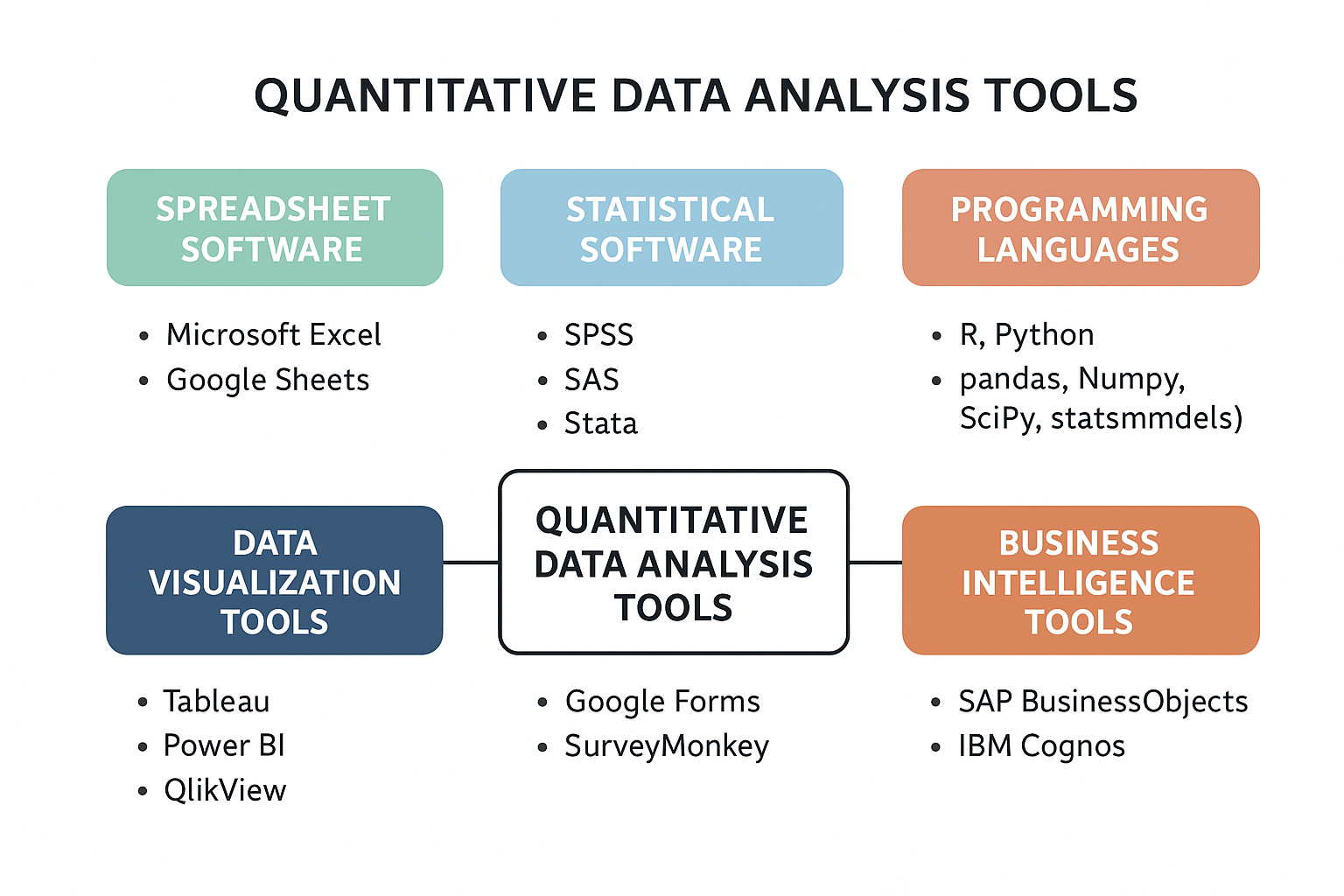
Picking the right tools for the measurable data analysis is key to making wise choices. Also, it is the main thing to execute calculable data.
Below are the top tools for this data. These tools help analyze patterns, trends, a nd as well relations in datasets with accuracy and speed.
- Microsoft Excel– It is one of the best tools for quantitative data, ideal for basic stats analysis, pivot tables, and charts.
- SSPS– For complex statistical modelling and research, SPSS is widely used.
- R programming– It is a free tool for complex statistical analysis and data visualization.
- Python (Pandas, NumPy, SciPy): This tool is ideal for scripting quantitative analysis and managing big datasets.
- Chart Expo: A simple-to-use tool for making erudite Excel, Google Sheets, and Power BI graphics that make data insights simple to follow without the need for scripting.
Frequently Asked Questions
What is quantitative data analysis?
A: It is the practice of analyzing quantitative data using statistical tests and algorithms to make sense of numerical data. In order to make better selections, it assists you in recognizing trends, correlations, and patterns.
What are the perks of using quantitative data analysis?
A: These data can turn numbers into rich insights. Here are the key perks of using this tool. These are making decisions with trust, cutting expenses, analyzing and interpreting data, and displaying and distributing data.
How do quantitative data differ from qualitative data?
A: Quantitative data is totally free from bias, and it is used for numbers and counting. On the other hand, qualitative data is descriptive and relevant to language.


 Live Chat
Support
Live Chat
Support +44 161 381
0000
+44 161 381
0000 info@assignmentmaster.org.uk