 +44 161 381
0000
+44 161 381
0000 info@assignmentmaster.org.uk
 By
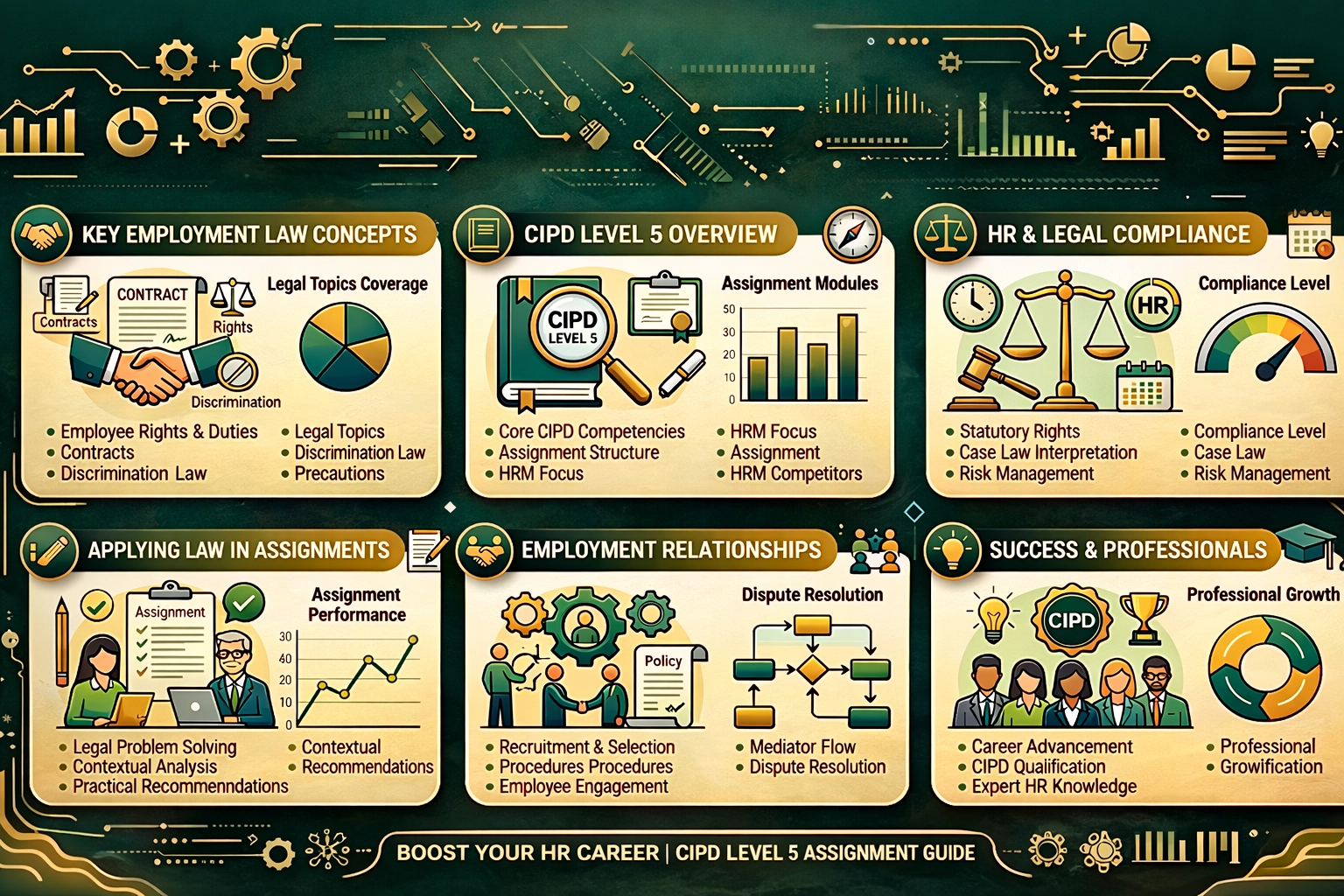
By Have you ever wondered why organisations must follow strict procedures before dismissing someone? Or why cannot companies treat employees differently based on gender, age, or background? Well, it is a common question among CIPD students. And the answer is also quite simple. It is due to the employment law. In cipd level 5 assignments, employment law actually plays a crucial role. You do not just have to understand its theory or concepts, but also gain practical experience. This will help you understand how you have to make informed decisions every single day as an HR professional. Let’s understand how you can do it.
What Is Employment Law?
Before starting our discussion, you must first know what employment law actually is.
Employment law basically refers to the legal rules that manage the relationship between employers and employees. It not only protects both sides but also ensures fairness and reduces workplace conflict.
In simple words, employment law answers questions like:
- What rights do employees have?
- What responsibilities do employers carry?
- How should dismissal be handled?
- What makes redundancy fair?
When you study CIPD programmes, you will learn how these laws affect real organisations. The focus at CIPD Level 5 also becomes deeper and more analytical. Now, you don’t have to just learn the definitions. Instead, you have to learn how to apply employment law effectively in real HR situations.
Understanding CIPD Level 5 and Its Value
Before we go further, many students remain confused about what the CIPD Level 5 actually is.
CIPD Level 5 is basically equivalent to a foundation degree in the UK. The level is not a full bachelor’s degree. However, it is intermediate and carries a strong professional value in HR roles. Beyond that, another common pathway is cipd level 5 Learning and Development (L&D), which focuses more on training, coaching, and organisational growth. Whether you choose HR or learning and development, you must remember that the employment law remains important in every CIPD route.
How Employment Law Is Explained in CIPD Level 5 Assignments?
Now let’s talk about the main part, which is how employment law is actually assessed in CIPD Level 5 assignments help.
CIPD Level 5 Employment Law Assignment Criteria
The CIPD Level 5 Employment Law assignment criteria usually require you to:
- Demonstrate understanding of key legislation
- Apply laws to workplace scenarios
- Analyse organisational risk
- Provide professional recommendations
At the CIPD level, you must go beyond basic explanation. You are expected to show critical thinking. You must link theory with practice.
For example, you may be given a case where an employee claims unfair dismissal. In your cipd level assignment, you would need to:
- Identify the relevant legislation
- Examine whether the employer followed a fair process
- Suggest improvements
This shows that CIPD level assessments focus on application, not memorisation.
Scenario-Based Questions
On top of that, in most cipd level 5 employment law assignment tasks, you are given realistic workplace situations. These tasks may include:
- Disciplinary procedures
- Redundancy consultations
- Discrimination complaints
- Contract changes
You must explain how employment law applies in each case. This practical approach prepares you for real HR roles, and that is the actual purpose of a CIPD qualification.
Policy Evaluation and Legal Compliance
Along with that, another important part of a cipd level assignment is reviewing company policies.
You might need to assess things that will teach you to reduce legal risk and learn how HR can protect the organisation while supporting employees. This includes:
- Whether a grievance policy follows legal standards
- If recruitment practices prevent discrimination
- Whether redundancy processes meet consultation requirements
Struggling with the complexity of your CIPD Level 5 assignments? Seek assistance from professionals!
Are you struggling with your CIPD Level 5 assignments due to their complexity? No worries because Assignment Master UK is at your rescue. Our experts ensure that they provide you with exceptional assignments, making CIPD concepts easier for you.

Key Employment Law Topics Covered in CIPD Level 5
Now, you must also know the main employment law topics that are covered in your Level 5 CIPD qualifications. These core topics include:
Recruitment and Contracts
To begin with, you learn how to create lawful contracts in this level. But what these contracts are actually about. Basically, these contracts are related to recruitment and other employee affairs. In addition to this, you can explore fair recruitment practices. It is important to be familiar with these lawful contracts, as it will help you avoid discrimination and be aware of the job role more effectively. It usually includes:
- Clear job descriptions
- Equal opportunity hiring
- Written terms and conditions
Equality and Diversity
Coupled with this, as a CIPD Level 5 student, you will also learn about equality and diversity. Likewise, recruitment and contracts, equality and diversity also help you avoid discrimination in the workplace. It allows you to study concepts, such as:
- Direct discrimination
- Indirect discrimination
- Harassment
- Victimisation
Discipline and Dismissal
Over and above this, maintaining discipline and preventing unfair dismissals is crucial as an HR professional. It also allows you to avoid a negative work environment. This is one of the reasons why the discipline and dismissal topic is included in CIPD qualifications. In these assignments, you may have to recommend the legal steps to prevent such situations in the workplace. Besides, it enables you to explore:
- Fair investigation procedures
- Employee rights during hearings
- Appeal processes
Redundancy and Consultation
Lastly, redundancy and consultation are also important topics in the CIPD. These topics allow you to understand the strict legal guidelines. In your CIPD level assignments, you may assess whether a company followed fair consultation procedures. This shows how employment law connects directly to business decisions.
Why Employment Law Knowledge Is Crucial for HR Professionals?
Now, you might be thinking, why does cipd level place so much importance on employment law? Well, the reason is simple. The HR professionals are actually responsible for ensuring adherence to laws. A simple mistake can cost organisations thousands in legal fees or a damaged reputation. These mistakes can include unfair dismissal, mistakes in contracts, and discrimination. However, through CIPD qualifications, you can develop the confidence to:
- Advise managers correctly
- Reduce legal risk
- Promote fairness
- Build a positive workplace culture
This is especially true at cipd level 5, where you are trained to operate as an HR advisor, and not just an administrator. Whether you are studying HR or cipd level 5 Learning and Development (L;D), understanding employment law strengthens your professional credibility.
Wrap Up!
All in all, employment law is the legal framework that not only protects employees but also guides them and ensures fairness, transparency, and accountability in the workplace. In a CIPD Level 5 employment law assignment, you are not just asked to define legal terms. Instead, you are required to:
- Analyse situations
- Evaluate policies
- Provide professional recommendations.
The criteria of these assignments demand critical thinking and practical understanding. However, by mastering employment law, you can build the skills needed to succeed in HR roles. Best of luck with your CIPD journey and your future in HR!
FAQs
- Is CIPD Level 5 difficult?
Ans. Yes, CIPD Level 5 is generally considered fiffcult among studnets, especially if they are new to employment law or HR theory. However, it is manageable if you stay organised and understand the assignment criteria clearly.
- What is the CIPD Level 5 employment law module?
Ans. The CIPD Level 5 employment law module focuses on understanding workplace legislation and how it applies in real HR situations. It also teaches you about
- Unfair dismissal
- Discrimination
- Contracts
- Employee rights
- How does CIPD Level 5 work?
Ans. CIPD Level 5 is usually assignment-based rather than exam-based. You complete written tasks, case studies, and workplace-focused assessments.
- What is the CIPD course on employment law?
Ans. The employment law is a part of a CIPD course that explains the legal framework that governs employer and employee relationships. The focus is on helping HR professionals reduce legal risks and ensure compliance. It covers topics like
- Fair dismissal
- Equality
- Redundancy
- Workplace rights
- Is Level 5 equal to a degree?
Ans. Yes, level 5 is generally considered equivalent to a foundation degree in the UK.
- Is CIPD Level 5 internationally recognised?
Ans. Yes, CIPD qualifications are widely recognised, especially in the UK and many other countries.
- Can I work in HR without CIPD?
Ans. Yes, you can work in HR without a CIPD qualification, especially in entry-level roles. However, many employers prefer or require CIPD for mid-level and senior HR positions.


 Live Chat
Support
Live Chat
Support +44 161 381
0000
+44 161 381
0000 info@assignmentmaster.org.uk