 +44 161 381
0000
+44 161 381
0000 info@assignmentmaster.org.uk
 By
By Do you know what is crucial for becoming an impactful leader? If you don’t know, then let me tell you. It is a reflective practice. It is the active process of analysing one’s own actions, decisions, and experiences to enhance learning and professional growth.
In that regard, Gibbs’ reflective cycle provides a 6-stage framework to personal and professional growth through reflective practice. It is designed for various professionals to turn experience into learning. Moreover, this six-stage reflective model involves analysing what happened, why it happened, and how to improve.
If you want to know more about Gibbs’ reflective cycle, its stages in detail, pros and cons, and how leaders utilise this framework, then keep reading this blog.
What is Gibbs’ Reflective Cycle?
Considering the Gibbs’ reflective cycle only as a theoretical model is wrong. This is because it’s not only about understanding your experiences but also turning them into practical takeaways and strategic recommendations.
It was developed by Graham Gibbs in 1988 with the aim of enhancing personal and professional development. It comprises six stages, including a systematic method of reflection.
Through your reflection, you will understand your experiences better, and as a result, it will lead to an upgrade in leadership skills, decision-making abilities, and emotional intelligence.
This model encourages individuals to think deeply about situations(which experiences went well and which did not), understand their reactions, evaluate outcomes, and plan improvements for the future.
However, if you are a leader, then you can also use this cycle to improve your leadership approach and embrace continuous learning in your team.
What are the stages of Gibbs’ reflective cycle?
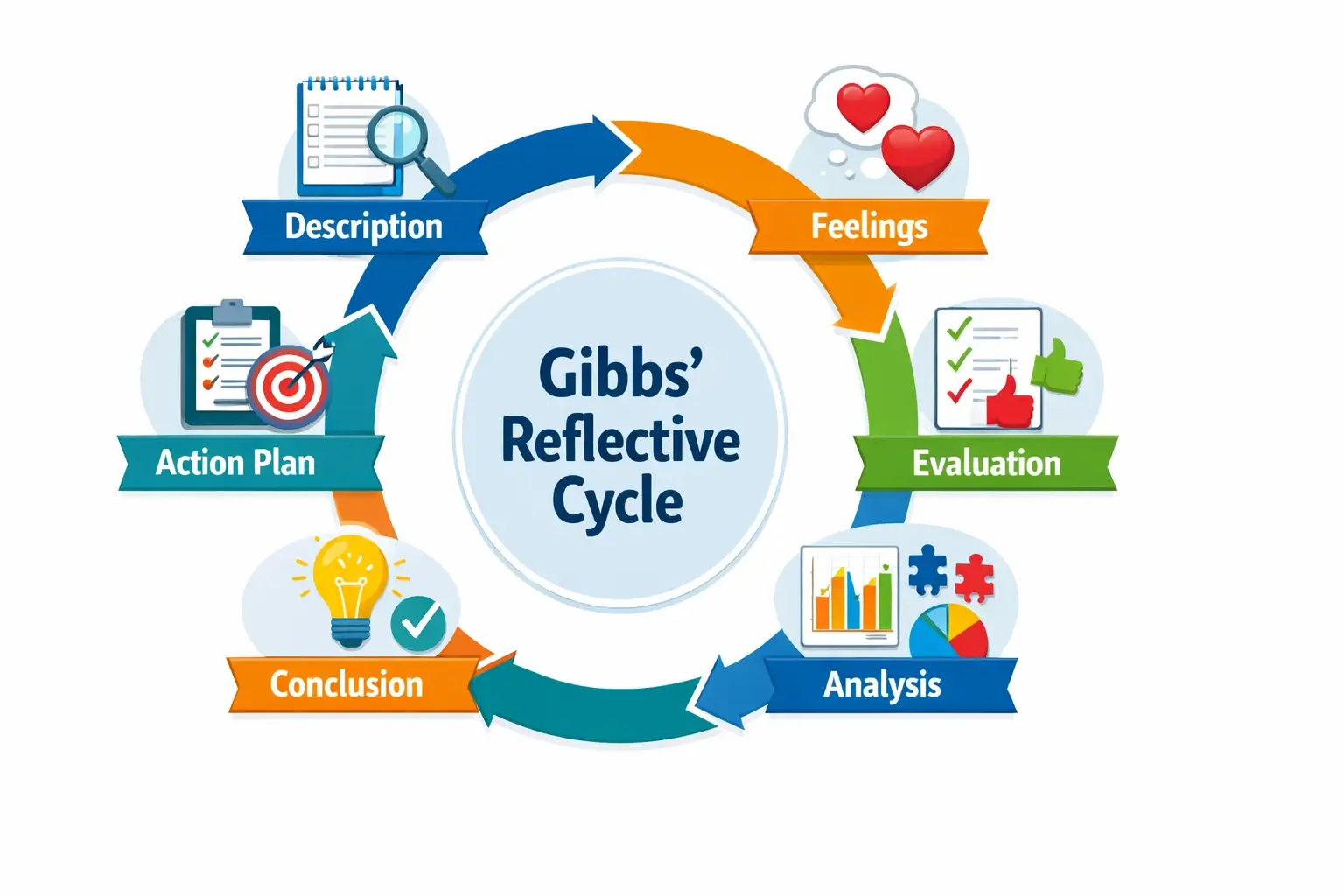
- Description.
- Feelings
- Evaluation.
- Analysis.
- Conclusion.
- Action plan.
Moreover, these stages create a continuous loop of learning from one experience and its influence on future behavior.
This model is commonly used in fields like education and teacher training, nursing and health care practice, business and leadership training, and professional development programs.
Now, let’s discuss each stage of this reflective model in detail.
Description:
This is the first stage of Gibbs’ reflective cycle. In this stage, you have the opportunity to describe the situation and experience you want to reflect on. Moreover, the description of the situation should be accurate and factual, without any interpretation, analysis, bias, or judgment. In this, objectivity matters.
The situation can be a leadership issue, a team conflict etc. The following factors can help you in describing your situation:
- Context: where did the event take place? When did it take place: during a meeting, or a casual interaction?
- Participants: how many people were involved?
- Evensta as a sequence: what exactly happened? What are the facts about it? What was the order of events?
- Purpose: What’s the main reason behind the event? Why did it happen? What was the goal or purpose of it?
- Your actions: What actions were taken by you?
- Outcomes: What was the end result of the event?
This stage mainly includes the background and the factual information related to the event you want to reflect upon.
Example: if you are reflecting on a team meeting, then you must discuss where it took place and at what time. Who was involved, what really happened in the meeting; agenda, key discussions, and meeting outcomes.
Feelings:
In this stage, you must reflect on your internal experience, emotional aspect, and feelings related to the event. This is important because leaders often react and make decisions based on their emotions. Also, it involves self-reflection and self-awareness.
- What was your first gut reaction?
- Did your emotions change as time passed?
- How did others involved feel? Was there any reaction or feedback?
- Why were you feeling that way?
- How did external and internal experiences influence your feelings?
The key tip is to be honest, whether you feel frustrated or powerless, you have to inform your behavior.
Example: consider a scenario where you were attending a project meeting. Initially, you felt frustrated when you thought your ideas were not considered or questioned.
However, after the meeting, you may have realised something different.
The shift in your thoughts and feelings reflects your emotional journey during and after the event.
Evaluation:
In the evaluation stage, you must reflect on the experience and identify what worked well and what did not. It involves discussing the event from both positive and negative aspects.
- What worked well? How did the team respond to your leadership skills?
- What did not go according to plan? What were the challenges and failures in your leadership?
- Was the overall event positive or negative, and why do you think that way?
- Did your actions result in success or failure?
Example: consider a scenario in which you have completed a project successfully. However, you notice some areas of improvement related to the communication gap, which, after improvement, will lead to more successful projects in the future.
Analysis:
In this stage, you must analyse the event in depth, including why the event happened the way it did. Consider the causes, patterns, and dynamics.
- Why did the situation unfold in this way?
- What caused positive and negative outcomes?
- Is there any model or theory that can relate to the event?
- How did your actions influence the outcome?
- How different actions would have changed the outcome?
Example: imagine that you experienced team conflict over a project. You can apply a communication theory, which makes you realise that conflict was caused by the different interpretations of project goals.
Conclusion:
In this stage, you reflect on the lessons that you have learned from the event and how you will tackle the same event differently in the future by using different strategies.
- What have you learned from this experience?
- What should be continued based on this experience, and what should be changed?
- How could you tackle the situation differently and effectively?
- What are the areas for personal growth, and what skills will help in the future?
Example: you understood that the delays were due to last-minute changes; therefore, you concluded that a clearer project timeline will help in the future.
Action:
This stage involves turning the reflection into action. It includes the plan to deal with future situations.
- What steps will you take if a similar situation occurs again?
- What skills do you need to develop?
- What strategies will help improve future outcomes?
- How will you prevent negative outcomes in the future for the same situations?
For example, I will use a structured approach for conflict resolution in the future, set clear guidelines for discussions, and intervene initially to solve the issue. I will also train myself to manage difficult conversations.
What are the benefits and limitations of Gibbs’ reflective cycle?
If you are thinking why use Gibbs reflective cycle, then consider these benefits.
Gibbs reflective cycle benefits:
- Provides a clear structure: This model is simple and organised. These six key stages of this model make reflection easier.
- Encourages deep learning: This cycle encourages individuals to think in-depth about an experience.
- Promotes self-awareness: Through this model, individuals understand their emotional responses and behavioral patterns.
- Leads to continuous improvements: The action plan ensures that reflection leads to real change and development.
- Useful across many professions: The model is flexible and can be applied to various professions and fields.
Gibbs reflective cycle disadvantages:
- Time-consuming: These six stages may take a lot of time.
- Not suitable for complex situations: In certain events, this model may not provide enough depth to analyse all factors involved.
- Self-honest reflection: The effectiveness of this model depends on the individuals’ willingness to reflect honestly on their actions and emotions.
How do leaders use the Gibbs’ reflective cycle?
- Improving decision-making.
- Learning from success and failure.
- Developing emotional intelligence.
- Enhancing team performance.
- Improving leadership skills.
All in all!
Gibbs’ reflective model is one of the most practical and widely used models for reflective learning. This provides a six-stage process that assists individuals in analysing their experiences, understanding emotions, evaluating outcomes, and developing strategies of improvement. Moreover, this framework leads to actionable learning, which results in continuous personal and professional development.
FAQs:
- What are the advantages of the Gibbs Reflective Cycle?
The advantages of Gibbs reflective cycle include: a structured approach for growth, encouraging deep learning, developing emotional intelligence, being action-oriented, versatile, and leading to self-awareness.
What is the Gibbs Reflective Cycle in the UK?
Gibbs reflective cycle is a structured framework in the UK for professional and academic reflection. It was developed by Professor Graham Gibbs in 1988 to help individuals learn from experiences.
- What are the 5 C’s of reflection?
The 5 C’s of reflection are Continuous, Connected, Challenging, Contextualized, and Coaching.
- Why is reflection important in nursing in the UK?
Reflection is critical in UK nursing for improving patient care, fostering professional development, and meeting the Nursing and Midwifery Council (NMC) requirements for revalidation. It helps nurses translate experiences into learning, bridging theory and practice.
- What are the 5 benefits of self-reflection?
There are many benefits of self-reflection, such as it leads to self-awareness, increased emotional intelligence, better decision-making and reduced stress.
- What are the six stages of reflection?
Description, Feelings, Evaluation, Analysis, Conclusion, and Action Plan.


 Live Chat
Support
Live Chat
Support +44 161 381
0000
+44 161 381
0000 info@assignmentmaster.org.uk