 +44 7933 142807
 info@assignmentmaster.org.uk
 By
By When it comes to job offerings, employers mostly prefer candidates with higher education. But education is actually not enough. An ideal candidate must also possess a broader understanding of business. Also, the candidate must have strong essential skills that include strategic planning and leadership skills. One of the most preferred degrees among hiring managers is an MBA degree. But what does an MBA stand for? It basically stands for Master of Business Administration. It is a graduate-level degree that offers theoretical and practical training for leadership and business management.
MBA is actually one of the most popular degrees globally, and is often referred to as a “career accelerator”. The reason is salary growth and career advancement opportunities. Additionally, MBA students have a strong grasp on:
- Data analytics
- AI
- Digital literary
This increases their value in the job market worldwide.
Now, let’s explore MBA beyond the acronym. So, are you ready? Let’s dive into it!
What is an MBA, and What Does MBA stand for?
Before we start our discussion, let’s first understand what is mba, what does MBA stand for, and what students actually learn in an MBA.
MBA stands for Master of Business Administration. Let me explain the MBA meaning in simple words. An MBA is basically a postgraduate degree that enables you to develop the essential skills required for
- Managing business
- Making strategic plans
- Leading teams
But what do students actually learn in an MBA?
The following are the core topics that students learn in an MBA:
Finance and Accounting:
Students understand financial reports, budgets, and money.
Marketing:
In addition to this, students learn how they can sell services and their products. Furthermore, they also learn how to build their own brand.
Strategy:
Besides that, peers get the grasp on making strategies and developing plans for the long-term success of businesses.
Operations:
Moreover, students can also improve their efficiency and manage supply chains.
Leadership and Organisational Behaviour:
Furthermore, peers can also learn how they can manage people and company culture.
MBA as a Postgraduate Degree
I hope you have clearly understood what does an MBA stand for. Let’s also talk over what’s an mba degree by understanding mba degree definition.
MBA Definition:
An MBA acronym for Master of Business Administration, is a prestigious postgraduate degree. In addition, it is a professional degree that is internationally recognised. Besides that, it offers advanced and comprehensive training in
- Entrepreneurship
- Business management
- Leadership
- Strategic planning
Entry Requirements:
The following are some key entry requirements for an MBA:
Bachelor’s Degree:
First and foremost, you must have a bachelor’s degree from a recognised university. Besides, not all, but some programs also require a minimum GPA of 2.5 or higher.
Work Experience:
Moreover, you should also have relevant work experience in the industry. Although some programs accept candidates with no experience, most of the programs require at least 2-5 years of experience.
Standardised Tests:
Besides that, you must also take the GMAT (Graduate Management Admission Test) or GRE (Graduate Record Examination). These scores are quite crucial to assess your analytical and quantitative skills.
English Proficiency:
In addition to this, you must also be proficient in English. To ensure that, you also have to pass IELTS or TOEFL.
Duration:
But the question is, how long is an mba? Well, the duration of the MBA solely depends on the type of MBA degree you are pursuing. However, its standard time span is 1.5 to 2 years. But you must remember that the duration may vary based on your type of degree.
Types of MBA Degrees
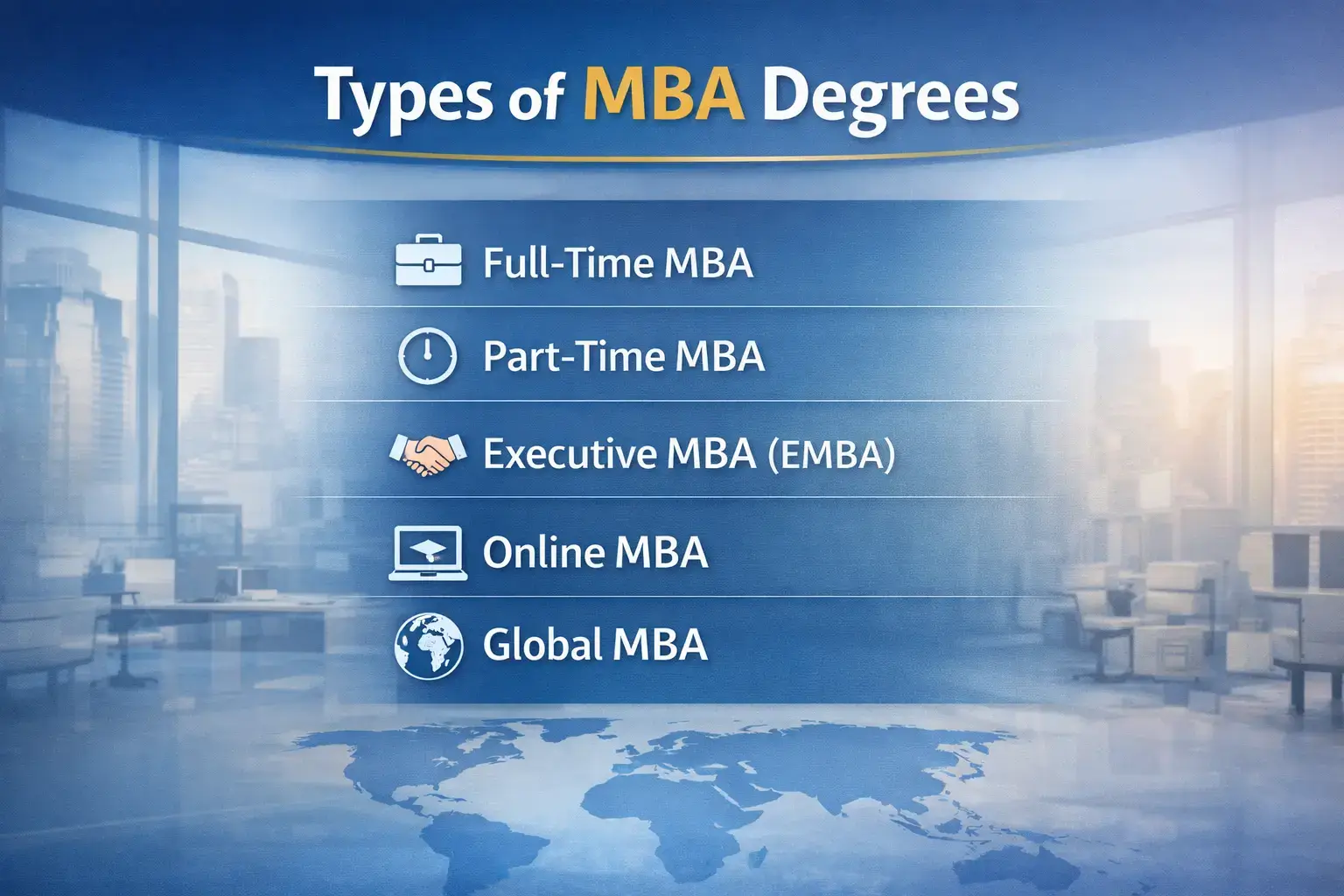
Now that we have a clear understanding of what an MBA degree stands for and what it actually is, let’s have a look at the types of MBA degrees.
The types of MBA degrees range from part-time to global MBA. Let’s take a closer look at these types:
Full-Time MBA
First of all, the Full-Time MBA is the most traditional option. Students attend classes regularly and complete the program within two years.
This option is ideal for:
- Fresh graduates
- Professionals planning a career switch
- Individuals who can commit full-time
Full-Time MBA stands for complete immersion in business education.
Part-Time MBA
Besides that, the Part-Time MBA is designed for working professionals. Moreover, classes are usually held in the evenings or on weekends.
It allows students to:
- Continue their jobs
- Apply learning directly at work
- Manage studies with flexibility
This option answers the question of how long an mba for working professionals is. It may take 2–3 years, depending on the pace.
Executive MBA (EMBA)
Furthermore, the Executive MBA is specially designed for senior professionals with significant experience in the industry.
EMBA programs focus more on:
- Strategic leadership
- High-level management
- Corporate decision-making
If you are wondering what an mba degree is for executives? This is the answer.
Online MBA
Additionally, Online MBA programs are also gaining immense popularity worldwide. They offer flexibility and remote learning to MBA students.
Students can:
- Study from anywhere
- Balance personal commitments
- Learn at their own pace
Online MBA also offers accessibility and convenience.
Global MBA
Lastly, the Global MBA focuses on giving international business exposure to MBA students.
Students often:
- Study in multiple countries
- Learn about global markets
- Build international networks
This type is perfect for those who wish to work in multinational companies.
MBA assignments can be quite difficult, and managing these assignments with your job can be challenging. This is why many MBA students often seek MBA Assignment help from professionals. If you want to know how seeking MBA Assignment Help can be beneficial, you can take a look at Work Better With UK MBA Assignment Writers.
| Struggling with your MBA assignments? Seek professional help!
Are you also struggling with your MBA assignments? Don’t worry because assignmentmaster.org.uk is here to help you. We provide you with top-notch assignments, along with round-the-clock assistance from our experts. Contact now! |
Why Do Students Choose an MBA?
You must be wondering why students choose to pursue an MBA. Right? Well, there are many reasons why the MBA is one of the most popular postgraduate degrees globally. But the question is still why? Basically, students pursue an MBA to advance their careers, increase their earning potential, and switch industries. The following are some benefits of pursuing an MBA that make it an ideal choice for students.
Career Growth:
First and foremost, an MBA degree can be really beneficial for graduates to enhance their career growth. Most of the employers prefer MBA graduates for job roles. The reason? Strong grasp of essential skills required for business management, strategic planning, and leading teams. In other words, an MBA degree helps you stand out among other applicants.
Salary Increase:
In addition to this, pursuing an MBA degree also increases your earning potential. The reason for this is that employers mostly choose MBA graduates for senior-level positions. As a result, MBA degree holders get a comparatively higher salary than others. This is actually one of the most common reasons why students choose an MBA.
Leadership Roles:
Besides that, having an MBA degree means that you can directly enter leadership roles. This is because, for an MBA degree, you must have relevant work experience. This means that once you get an MBA degree, you can easily secure leadership roles. Another reason why employers choose MBA students for these roles is their strong grasp of leadership, as well as other crucial skills.
Industry Switch:
Moreover, many students also pursue an MBA to switch industries. For example, an engineer may move into finance or marketing after completing an MBA. This flexibility is actually what makes the degree highly valuable globally.
Who Should Study MBA?
Now that you understand what an MBA stands for, the next question is simple. Who should actually pursue it? Many students keep asking whether an MBA matches their career goals or not. The truth is that an MBA helps with growth, leadership, and better opportunities. Let’s see who can benefit the most.
Fresh Graduates
Fresh graduates can gain a strong start through this degree. It builds a solid foundation in finance, marketing, and management. It basically helps young professionals step into senior-level roles a lotfaster. Additionally, it helps them stand out in competitive job markets.
Working Professionals
Besides, professionals with a few years of experience can also pursue an MBA degree. This will help them secure higher salaries and leadership roles.
Entrepreneurs
Also, business owners can get benefits by pursuing an MBA. If you are thinking what an MBA isgoing to teach me, the answer is strategy. An MBA also helps in smarter business planning, financial management, and effective marketing. It also reduces risks and improves long-term success.
International Students
International students often ask about global value. MBA is recognised worldwide, due to which students can get several international career opportunities. It also builds global networks and prepares students for leadership roles in multinational companies.
MBA Acronym – Final Summary
MBA, an acronym for Master of Business Administration, is indeed a highly valued degree not just in the UK or the US, but across the world. It can
- Enhance your career growth
- Increase your earning potential
- Help you secure leadership roles
- Switch industries
This brings us to the end of our blog!
I hope that this blog will be helpful for you to know what does an MBA stand for and what its value is in the global market. Best of luck with your future!
FAQ’s
- What does MBA stand for?
Ans. MBA stands for Master of Business Administration.
- What is an MBA graduate’s salary?
Ans. In 2026, the average salary of an MBA graduate can range from $120,000 to $200,000 per year.
- Is an MBA a real degree?
Ans. Yes, an MBA is a real postgraduate degree that is highly recognised worldwide.
- Is MBA higher than MSc?
Ans. No, an MBA is not higher than an MSc because both are postgraduate degrees. However, an MBA is generally considered a better option for career growth at a senior level.
- What is the purpose of MBA?
Ans. The following are the key purposes of an MBA:
- Career advancement
- Switching industries
- Developing essential skills
- Increased earning potential
- Is MBA a 2 year course?
Ans. Yes, an MBA is a 2-year full-time program, but the duration may vary based on countries.
- Which is the highest-paying job in MBA?
Ans. The highest paying jobs in MBA are:
- Executive management
- Consulting
- Finance


 Live Chat
Support
Live Chat
Support +44 7933 142807
 info@assignmentmaster.org.uk