 +44 7933 142807
 info@assignmentmaster.org.uk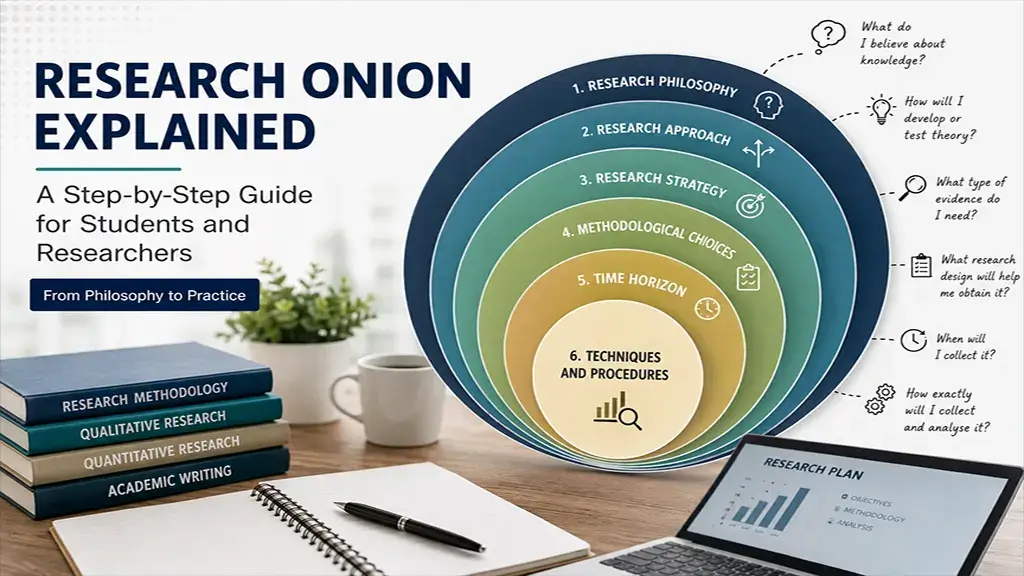
 By
By Imagine you have finally settled on your dissertation topic. You know what you want to investigate. You may even have your research questions written down.
Then your supervisor asks:
“What is your research philosophy?”
You know you want to conduct interviews and send a questionnaire. But suddenly you are being asked about ontology, epistemology, research approach, methodology, research design, strategy, sampling, and time horizons. This is where students feel that their research design has disappeared beneath a pile of terminology.
The research onion is designed to make that decision-making process easier.
Associated with Saunders, Lewis, and Thornhill, this framework presents research design as a sequence of connected decisions and helps in making practical choices about collecting and analysing data.
The framework is based on six layers, and each layer will help you identify the right question for your research paper.
This guide will explore all six layers and questions in detail, along with a real-world case study to apply the framework to a research question, and a checklist that you must go through before submitting your methodology.
Research Onion Explained: What Is It?
At its simplest, the research onion is a framework for planning and explaining the methodological decisions behind a research project. Saunders and colleagues use the
“Onion” metaphor because research designs can be thought of as layers: you begin with the broadest assumptions and progressively narrow your choices until you reach the practical techniques used to collect and analyse evidence.
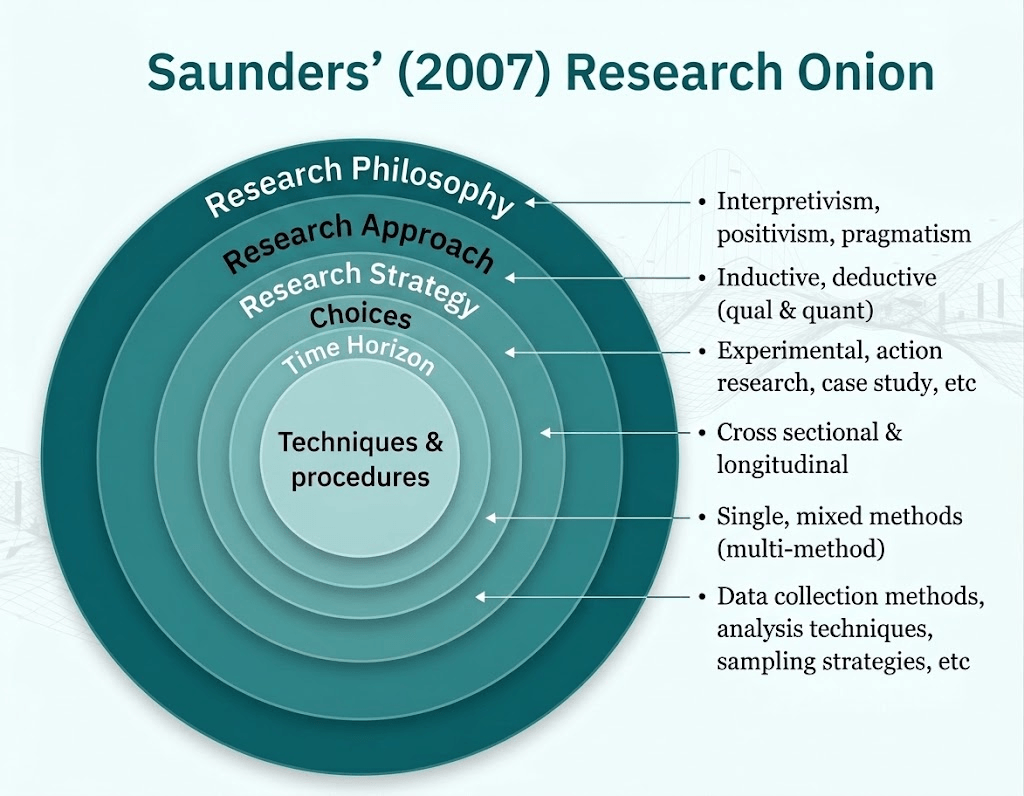
The model moves through the following six layers:
- Research philosophy
- Research approach
- Research strategy
- Methodological choice
- Time horizon
- Techniques and procedures
The outer layers deal with the broad questions, while the inner layers become increasingly practical.
You can think of the journey moving through the layers like this:
What do I believe about knowledge?
→ How will I develop or test theory?
→ What type of evidence do I need?
→ What research design will help me obtain it?
→ When will I collect it?
→ How exactly will I collect and analyse it?
These layers of Saunders ‘ research onion are perfect to apply to a dissertation methodology.
It helps you look at the entire research paper (every step of it) rather than simply deciding to go with interviews, surveys, or questionnaires.
Saunders Research Onion: Why the 2023 Edition Matters
One reason why students get confused about the research onion framework is that many explanations are based on the older version of Saunders’ model.
Well, those explanations remain useful, but the 2023 ninth edition gives researchers more conceptual details.
Saunders, Lewis, and Thornhill discuss:
- Ontology
- Epistemology
- Axiology
- Postivism
- Critical realism
- Interpretivism
- Postmoderism
- Pragmatism
- Deduction
- Induction
- Abduction
- Retrodeduction
Research Onion Layers Explained
The six layers are interconnected, but they should not be treated as rigid instructions.
Let’s examine what each layer means.
Layer 1: Research Philosophy
Research Philosophy is the outermost layer that refers to the assumptions you make about knowledge and reality. In simple words, it involves questions about reality, knowledge, and values.
If you are a researcher or a student working on your dissertation, start this first layer with the following three questions:
- What is reality?
- How can I know something about it?
- Do my values influence the research process?
Furthermore, research philosophy can be described from either an ontological or epistemological point of view.
What is Ontology?
Ontology concerns your assumptions about the nature of reality. It asks: what exists, and what is the nature of reality?
Imagine your dissertation investigates student engagement.
Is engagement something that exists as a measurable phenomenon that can be represented through attendance, participation, or survey response?
Or is engagement something that students experience or interpret differently depending on their circumstances?
Both of these perspectives can lead to legitimate research, but they produce different methodological decisions.
What is Epistemology?
Epistemology asks you how knowledge can be obtained and what counts as convincing evidence.
For instance, if you want to investigate student satisfaction, a numerical rating might be considered useful evidence.
However, if your question is why students feel dissatisfied, a conversation with students may provide evidence that a numerical score cannot.
Now, let’s look at the three main research philosophies that work on different ontological and epistemological assumptions:
- Postivism
- Interpretivism
- Pragmatism
Research Philosophy #1: Positivism
Positivism is a research philosophy that states that true knowledge is only found through empirical research, that is, observable, measured facts and objective reality.
For example, “I do not need opinions; give me facts,” is a common positivist approach.
In other words, what is being performed in research is done so objectively that there is no space for personal views.
Suppose you want to investigate:
- Does weekly study time predict undergraduate students’ academic performance?
You could develop measurable variables, formulate a research hypothesis, and analyse numerical data.
The research might follow this pathway:
Existing theory → Hypothesis → Measurement → Data collection → Statistical analysis → Findings
This can work well when your research question involves measurement, relationships, or hypothesis testing. However, there is a common oversimplification worth avoiding:
Quantitative research does not automatically equal positivism.
A positivist believes that knowledge can only be true, false, or meaningless. So if something is neither true nor false, that does not hold any ground value, and it is thus dismissed.
Research Philosophy #2: Interpretivism
The second philosophy, Interpretivism, seeks to understand the subjective meaning behind human social actions and experiences rather than measuring objective, universal laws.
Imagine the research question is:
- How do international postgraduate students experience academic feedback during their first year in the UK?
In this case, a five-point survey could tell you whether students are satisfied with feedback.
But interviews could show that students struggle because:
- Feedback terminology is unfair,
- Expectations differ from previous educational systems,
- Students are unsure whether they can question a lecturer,
- Written comments are interpreted differently,
- Feedback arrives too late to influence the next assignment.
Interpretivism therefore becomes pragmatic when your research is considered with experience, meaning, perception, and context.
It is often associated with qualitative research methodology, but do not turn an association into a rule.
Research Philosophy #3: Critical Realism
Critical realism adds another layer of thinking.
It distinguishes between what we observe and the deeper mechanisms that may produce what we observe.
For example, consider a university student whose attendance suddenly falls. So, a descriptive study might establish:
- Attendance declined by 18%.
It is useful but incomplete.
Conversely, a critical realist researcher may ask:
- What mechanisms or structures could be contributing to this outcome?
Potential examples might include:
- Timetable changes,
- Commuting difficulties,
- Financial pressures,
- Changes in assessment,
- Student perceptions of teaching,
- Institutional policies.
So, the observed decline is the event.
Here, the researcher is interested in the underlying mechanisms and conditions that may help explain it.
Hence, this makes critical realism particularly useful when the research question is concerned with explanation rather than simple description.
Research Philosophy #4: Pragmatism
Pragmatism takes a more problem-centred approach. It focuses on which approach is more useful for answering a research problem. It can be relevant to mixed-method studies in which qualitative and quantitative evidence serve different but complementary purposes.
For example, imagine that you want to investigate students’ use of university academic support services. A questionnaire might establish how frequently students use those services and which factors appear to be associated with usage.
Interviews can then explore why students make those decisions. If both forms of evidence are necessary, a pragmatic position may provide a defensible philosophical foundation for the design.
This step is what makes PhD researchers, and especially Master’s students that they have a lot on their plate. And it often leads to looking for someone to write my dissertation. Seeking external help can definitely assist you in understanding all the layers step by step, but it is you who is going to make every final decision.
Layer 2: Research Approach
Once you have chosen your philosophical position, the next question concerns how you will develop or use the theory.
There are three types of research approaches:
- Deductive
- Inductive
- Abductive
Deductive Approach
A deductive approach is when you start with existing theory or established ideas and then move toward empirical testing.
For example, suppose previous research suggests that perceived organisational support is associated with employee job satisfaction. Here, you could formulate a hypothesis predicting a positive relationship, collect data from employees and use statistical analysis to determine whether the evidence supports the proposition. The reasoning moves from theory to hypothesis to data and then to evaluation.
Inductive Approach
The inductive approach works in the opposite direction. Using this approach, you begin with observations or qualitative evidence and look for patterns that can contribute to theoretical understanding.
Imagine interviewing postgraduate students about dissertation supervision without assuming in advance exactly what makes supervision effective. You may discover recurring themes around accessibility, feedback quality, academic independence, and communication. Those patterns can then contribute to a conceptual understanding of effective supervision.
Abductive Approach
Saunders et al. describe abduction as involving the use of data to explore phenomena, identify themes and explain patterns, potentially generating or modifying theory that can subsequently be tested.
An abductive approach is best used when the relationship between theory and evidence is not clear. You might begin with existing research, collect data, and then encounter an unexpected finding that existing explanations do not fully account for.
You return to the literature, reconsider possible explanations, compare them with your evidence, and refine your interpretations. Abduction therefore involves moving between theory and empirical evidence.
Layer 3: Research Strategy
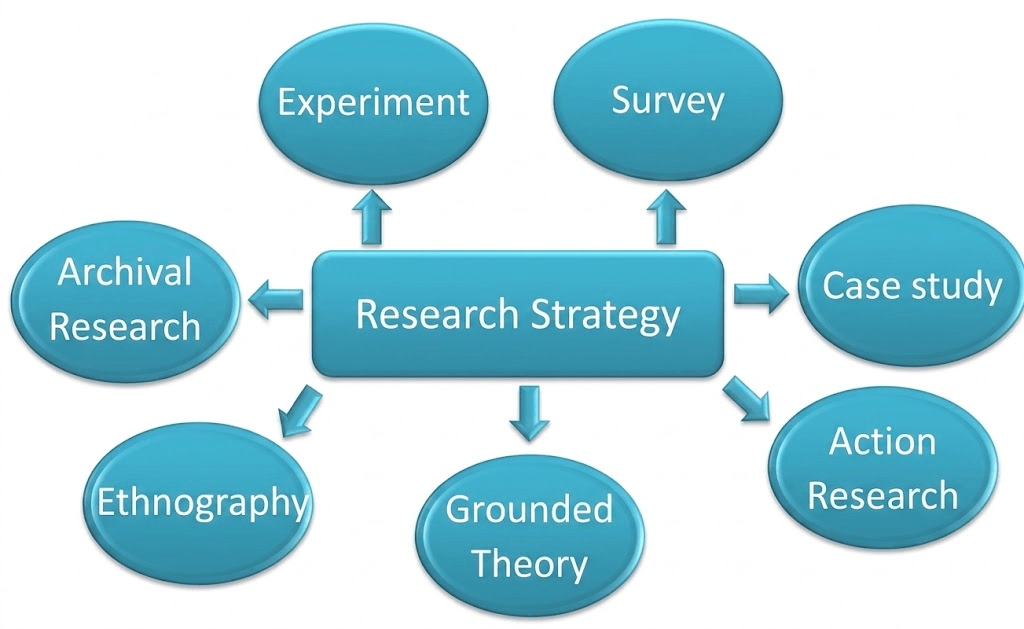
So far, we have peeled off the first two layers of the research onion framework, which were conceptual and intangible. Now comes the third layer that is more practical – research strategy.
This layer defines the overall plan of how you will answer your research question. Also, these strategies are referred to as research design.
The following are several research strategies:
- Survey: This is useful when you need structured information from a defined population.
- Experiment: This is more suitable when you want to investigate the effect of an intervention or controlled condition.
- Case study: This allows a PhD researcher to investigate a phenomenon in depth within its real-world context.
- Ethnography: This focuses on practice, behaviour and social interaction within a particular environment and community.
- Grounded Theory: This is concerned with developing theoretical understanding systematically from data.
- Action Research: It combines investigation with practical intervention and reflection.
- Archival Research: It uses existing documents or records as evidence.
Layer 4: Methodological Choice
This layer focuses on the types of research methods/choices one uses in their research. It is about deciding how many types of data (qualitative or quantitative research methodology) you will use in your approach.
The following are the three main choices:
- Mono
- Mixed
- Multi Method
Mono Method
Picking to work with a mono method means you will work with one type of data (qualitative or quantitative).
For example, if you were to conduct a study to understand students’ opinions on the use of the digital library in their institute, you would use the qualitative approach only so that you can study the participants’ views and opinions on the library.
Mixed Methods
Mixed methods are used when you want to use both qualitative and quantitative data. Let’s take the previous example. Now you want to know how many students have used the digital library. For this, you can use the survey method to gather quantitative data and then analyse the results statistically.
Multi Method
This is the last method that is used when you want to use a wider range of approaches in your research, like using more than only quantitative and qualitative.
For example, if you want to look at the cultures of an organisation, you’d conduct interviews with employees to learn their views on teamwork. You will also perform workplace observations to see real-time changes and see how leaders share values.
Need Professional Dissertation Assistance To Choose the Right Research Method?
Connect with a UK Dissertation Helper Online from us to save yourself from making a wrong decision.
Whether you need help to understand the layers of the research onion or clarity in choosing the right approach, our professionals have qualified degrees under their belt, providing personalised guidance to produce a high-quality dissertation.

Layer 5: Time Horizon
This fifth layer of the research onion framework is time horizon, which defines the timeframe or the number of data collection points for your study. It answers whether you are taking a single snapshot or tracking change over an extended duration.
The following are the two main choices in time horizon:
- Cross-sectional
- Longitudinal
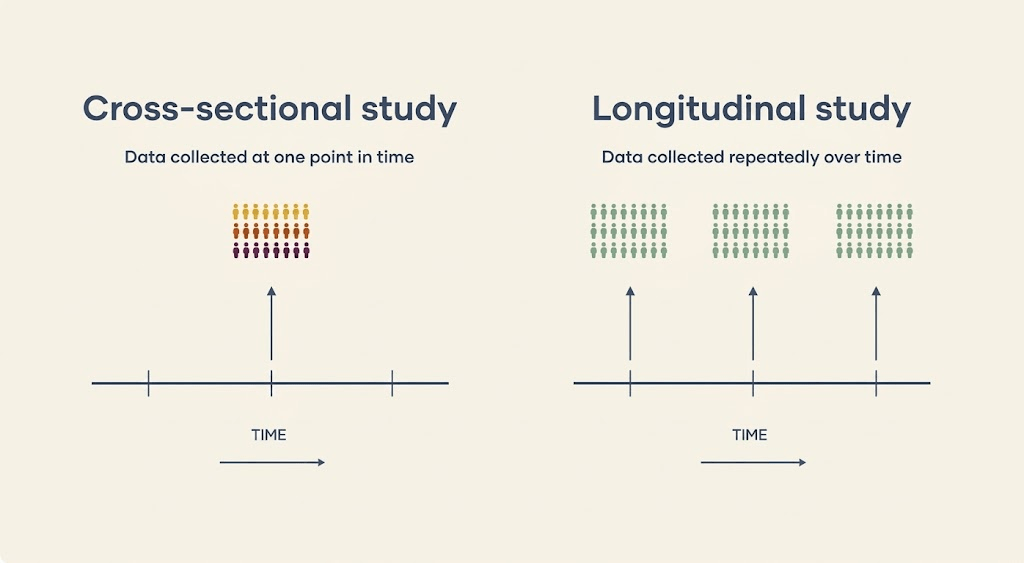
Cross-Sectional
Cross-sectional is used when you want to gather data at a single, specific point in time. It acts like a photograph, which makes it fast and practical for descriptive or correlational studies. However, it cannot show how things change over time.
For example:
- What are UK university students’ attitudes towards generative AI during the 2026 academic year?
You will collect the data once, and this is practical for many undergraduate and master’s projects because dissertation deadlines impose real limits. Also, the type of data collected could be qualitative, quantitative, or a mix of both because the focus is on the time of collection, not the data type.
Longitudinal
A longitudinal time horizon is used when you want to collect data across multiple points in time over months, quarters, or years. It acts like a video that lets you observe trends, developments, and shifts, which requires more time and resources.
For example:
- How do students’ attitudes towards AI change between their first and final years of university?
This is where you’d need to collect data over multiple points in time, such as over the years. Hence, the longitudinal time horizon is used in such a situation.
Layer 6: Techniques and Procedures
This is the last layer of the research onion framework and also the centre of the onion. It covers all the practical details of your research to make choices specifically for techniques and procedures.
This is the point where you will decide:
- What data you will collect and what data collection methods you will use.
- You will decide how you will select the sampling from the population (such as snowball sampling, random sampling, etc).
- You will also determine the type of data analysis you will use to answer your research questions.
A Real-World Research Onion Example for a Dissertation: Investigating Generative AI Use
I hope that you have understood all six layers of the research onion framework.
Now let’s put the entire framework together. Let’s say you are narrowing down a healthcare research idea; choosing the right topic should come before making your methodological decisions. Exploring current dermatology dissertation ideas can help you identify a focused research problem and turn a broad area of interest into a manageable dissertation question.
Once the topic is clear, you can work through each layer of the research onion and justify the philosophy, approach, strategy, methods, time horizon, and analysis that best fit your study.
Let’s take another example of a master’s student who wants to investigate:
- How does generative AI affect students’ perceptions of independent learning?
This is a timely topic, but it is still too broad. Hence, the researcher might refine it to:
- How do UK postgraduate students perceive the influence of generative AI tools on independent academic learning?
This helps in making the methodological decision clearer.
For the given research question, Saunders’s Research Onion can be structured as follows:
| Research Onion Layer | Recommended Choice | Application to Your Research |
| Research Philosophy | Interpretivism | The study seeks to understand how UK postgraduate students personally perceive and interpret the influence of generative AI on their independent learning. |
| Research Approach | Inductive | Themes and patterns will be developed from students’ responses |
| Research Strategy | Mono-method qualitative | Semi-structured interviews would be particularly suitable to find students’ experiences in depth. |
| Methodological Choices | Survey/ qualitative interviews | A qualitative method is best used here because the research focuses on students’ perceptions, experiences, and opinions. |
| Time Horizon | Cross sectional | Data will be collected from participants at one specific period. |
| Techniques and Procedures | Thematic analysis | Participants will be selected based on relevant characteristics, interviewed using open-ended questions, and their responses analysed systematically to identify themes and patterns. |
A Simple Research Onion Checklist
Before submitting your methodology, ask:
- Does my research question clearly identify what I want to discover?
- Have I explained my research philosophy?
- Have I considered my relevant ontological and epistemological assumptions?
- Have I justified my research approach?
- Does my methodology produce the evidence I actually need?
- Is my research design explained well?
- Have I justified my research strategy?
- Is my sampling strategy defensible?
- Have I explained my data collection process?
- Does my analysis match my research question?
- Have I addressed the ethics?
- Have I acknowledged limitations?
- Are my conclusions proportionate to my evidence?
- Can I explain why I made each methodological decision?
If you can answer those questions confidently, you are doing something much more valuable than simply “using the research onion”. You are demonstrating methodological coherence.
Frequently Asked Question
What is the research onion framework in simple words?
The research onion is a framework that helps academic researchers make and connect methodological decisions. It begins with philosophy and moves toward making practical choices such as sampling, data collection, and analysis
What are the six layers of the research onion framework?
The following are the six layers of the research onion framework:
- Research philosophy.
- Research approach.
- Research strategy.
- Methodological choices.
- Time horizon.
- Techniques and procedures.
Who developed the research onion?
The research onion framework was developed by Mark Saunders, Philip Lewis and Adrian Thornhill.
Is the research onion a research method?
No, it is a framework for thinking through methodological choices. Your methodology is the reasoned explanation of why those choices are appropriate for your research.
Can I use mixed methods with the research onion?
Yes, Mixed methods can be appropriate when both numerical and qualitative evidence are needed to answer different or complementary aspects of the research problem.
What is the difference between research design and research methodology?
Research design describes the overall structure of the study, while methodology explains the reasoning behind the approach and methods used.
What is the difference between deductive and inductive?
Inductive reasoning moves from specific observations to broad generalisations, while deductive reasoning works from general premises to guaranteed specific conclusions.
Do I have to use every research onion layer in my dissertation?
You should address the methodological decisions relevant to your research, but you should not mechanically describe every possible option. The important thing is to explain the choices that genuinely apply to your study.
Bringing It All Together!
Writing a dissertation methodology can feel tedious and complicated when you are faced with unfamiliar terms and a long list of methodological decisions. The research onion makes that process more manageable by helping you move logically from broad philosophical assumptions to practical decisions about your data, sampling, collection, and analysis.
Use the six layers of the research onion to understand why each methodological choice fits your research question. Whether you choose interpretivism and interviews, positivism and statistical analysis, or a mixed approach, your decisions should work together and be properly justified.
Also, before submitting the methodology, take a step back and ask yourself: Can I explain why I made each decision, and does my chosen methodology help answer my research question? If the answer is yes, you are not just applying Saunders ’ Research Onion; you are demonstrating methodological coherence and building a stronger foundation for your research.


 Live Chat
Support
Live Chat
Support +44 7933 142807
 info@assignmentmaster.org.uk