 +44 7933 142807
 info@assignmentmaster.org.uk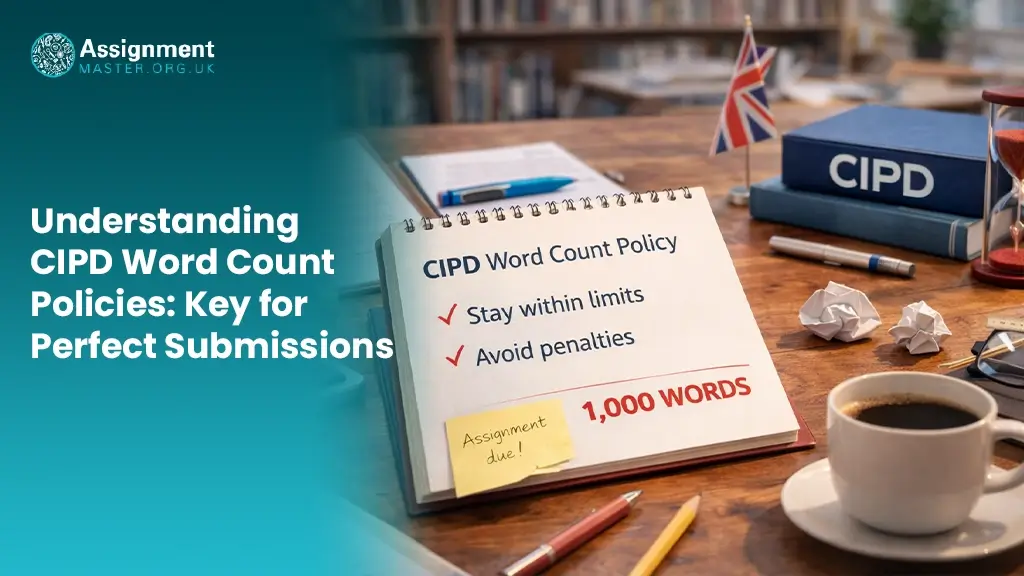
 By
By Imagine you wrote a CIPD assignment of 3,842 words. You were confident while submitting it. But then you got feedback, you were shocked to read: “Exceeded word count. It lacks clarity!”
That is to say, more words don’t promise better marks.
You need to follow the CIPD word count. It plays a decisive role in the assessment of your assignment. In other words, exceeding or falling short of the word limit can affect your grades.
Yes, even when the content quality is strong! So, what should you do? Read this blog! Here you will learn about the CIPD word count policy and some practical tips to manage it.
Let’s dive in!
What is the CIPD word count policy?
First, let’s answer the most important question:
Is there a hard word limit for CIPD Assignments help? No! The CIPD word count is not a strict fixed number. However, it follows a tolerance range.
That is to say, most CIPD assignments allow a ±10% variation. For example:
- If you write an assignment of 2000 words, it can range between 1800 and 2200 words
- When you write an assignment of 3000 words, you can go for 2700 to 3300 words
So, you can check that this flexibility exists within the CIPD Word Count Policy 2025. It ensures learners focus on quality rather than forced length. But why does it matter?
Why does the CIPD word count policy matter?
CIPD students! Your assessors expect you to write structured, concise, and relevant assignments. Most importantly, they must align with UK academic standards.
The CIPD word count is important for academic and professional reasons as it:
- Encourages concise communication
- Tests analytical and prioritisation skills
- Reflects practical HR reporting standards
- Aligns with assessment criteria
So, follow the CIPD word count policy. If you don’t, it shows your weak planning and lack of academic discipline. Is the CIPD word count the same across all levels? Read more to find out!
The CIPD word count for all levels?
With each level, the complexity and demand of analysis increase.
That is to say, when you write CIPD Level 5 assignments, you need deeper analysis. The CIPD Word Count Policy Level 5 expects:
- More balanced arguments
- Use of models and frameworks
- Claims based on evidence
- Critical evaluation
For that, you need to understand the indicative word count meaning. It refers to a suggested length rather than a rigid requirement. So, you don’t aim to write more, plan to write better. In other words, every section of your assignment must contribute to the assessment criteria. But does that include references, too?
What is included in the CIPD word count?
Confused about what counts within the word count? Don’t worry, in this section of the blog, you will understand what counts within the CIPD word count.
Here are sections of your assignment included in the CIPD word count:
- The main body paragraphs
- All citations within text
- Headings and subheadings
But here are sections excluded from the CIPD word count:
- Reference list
- Bibliography
- Appendices
- Tables
So, always check assignment guidelines, and you can adhere to the CIPD word count policy. But if you don’t do that, what are the consequences? To find out, read the following!
What happens if you exceed or miss the CIPD word count?
When you exceed or miss the CIPD word count, you lose marks!
That is to say, the CIPD word count impacts your marking:
- When you exceed, assessors stop reading beyond the threshold.
- If you fall short, assessors see it as a lack of depth and weak analysis.
So, it is important to maintain the correct CIPD word count. It ensures a fair assessment of all your arguments.
5 Practical tips to manage CIPD word count
So, here comes the section of the blog you have been waiting to read. Here are 5 Practical tips that can help you manage the CIPD word count of your assignments.
1. Plan before you start writing
Take some time to plan. If you do enough planning before you start to write, there is no way you will exceed the word count.
So, break the total CIPD word count across each assessment criterion. This prevents overwriting in one section.
2. Be Concise
While writing your assignment, use precise language. That is to say, avoid repetition and filler words. This will help stay within the word count.
3. Edit with focus
This is the most important tip. Without editing, your assignments will be filled with unnecessary explanations. So, replace long phrases with shorter alternatives.
4. Use tables and visuals
Tables and visual diagrams can summarise information. This helps in managing the CIPD word count burden.
5. Focus on assessment criteria
Lastly, when writing your CIPD assignments, you must focus on the assessment criteria. In other words, each paragraph should link to the marking requirements. This keeps the CIPD word count purposeful.
Some FAQs on CIPD word count
- How many assignments for CIPD level 5?
Ans. There are 3 to 5 core units in CIPD level 5, each containing multiple assessments.
- How to trick the word count?
Ans. Never attempt to manipulate the word count. You can lose marks! So, be concise while writing.
- What is the rule for word count?
Ans. Stay within ±10% and ensure alignment with assessment criteria.
- What is not counted in the word count?
Ans. Bibliographies, appendices, and reference lists are excluded.
- Can Turnitin detect word count?
Ans. Yes, Turnitin detects and displays the word count for submitted documents.
- What happens if you submit an assignment under the word count?
Ans. Submitting below the CIPD word count shows insufficient analysis. This results in lower marks.
- Are tables included in the CIPD word count?
Ans. Tables are often excluded. But seek confirmation from the assignment guidelines.
Final Thoughts
CIPD students!
Following the CIPD word count does not limit your ideas. It sharpens them! That is to say, the adherence to the CIPD word count policy ensures you have:
- Good structure in your assignment
- Precise language
- Stronger academic performance.
- Clarity
- Professionalism
- Understanding of HR concepts.
So, manage your word count to create the most outstanding assignment and achieve high marks!


 Live Chat
Support
Live Chat
Support +44 7933 142807
 info@assignmentmaster.org.uk